

German cockroaches are one of the most common and hardest-to-eliminate indoor pests. Because they hide in tight cracks and reproduce quickly, identifying them correctly is essential for early detection and effective control. Their appearance changes dramatically throughout their life cycle—from egg case to nymph to full adult—so knowing what each stage looks like helps confirm an infestation before it spreads. Below is a complete guide to identifying German cockroaches based on color, shape, size, markings, droppings, and nesting habits.
Identification
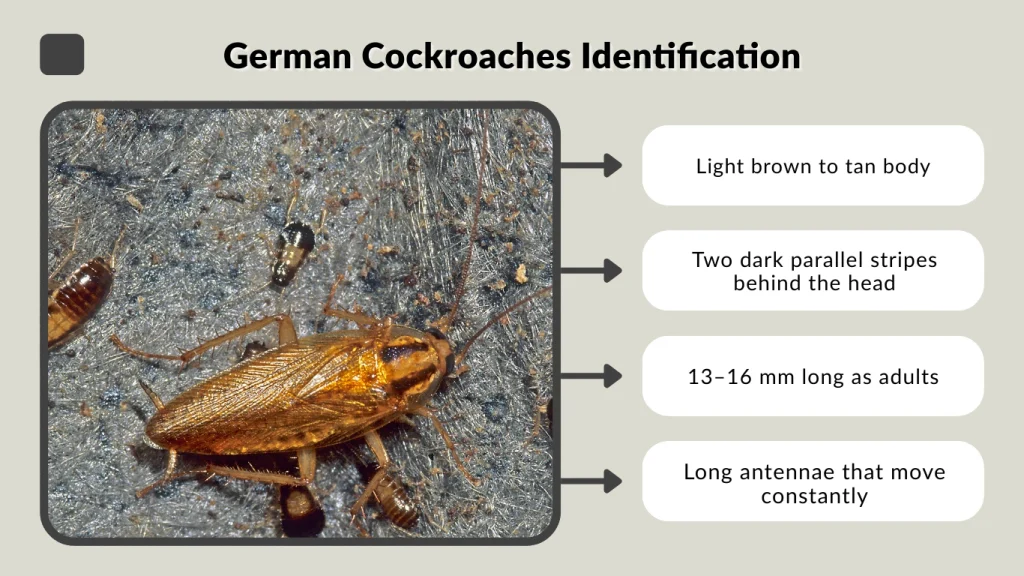
German cockroaches have several distinctive features that make them easier to recognize once you know what to look for:
- Light brown to tan body
- Two dark parallel stripes behind the head
- 13–16 mm long as adults
- Long antennae that move constantly
- Flattened body suitable for squeezing into cracks
- Wings present but rarely used for flying
These traits are consistent across both males and females, with minor differences in size and body shape.
Adult German Cockroach Appearance
Adult German cockroaches are typically light brown or tan, with two bold black stripes located on the pronotum (the shield-like section behind the head). These stripes are the most reliable identification feature and appear on every adult.
Size and Shape
Adults measure between 13–16 millimeters in length and have a flat, elongated body designed for hiding. They move quickly, often darting into cracks when exposed to light.
Wings and Movement
Although adults have wings, they do not fly. Instead, they rely on fast running and hiding. Their long antennae help them detect movement, food, and danger.
Male vs Female Differences
- Males are slightly thinner and lighter.
- Females are broader and darker, especially when carrying eggs.
These differences become more noticeable during heavy infestations.
What Baby German Cockroaches (Nymphs) Look Like
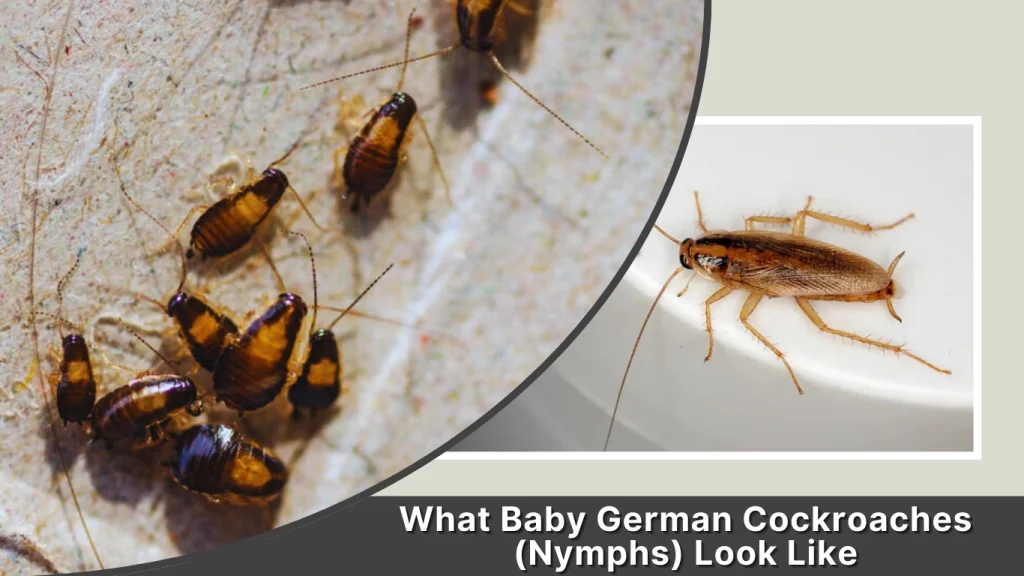
German cockroach nymphs look very different from the adults and are often mistaken for a completely different insect. They are:
- Dark brown to almost black
- Wingless
- Small (2–5 mm depending on age)
- Fast-moving, especially when disturbed
Early-Stage Nymphs
Newly hatched nymphs are tiny—sometimes as small as a pepper grain. They appear uniformly dark with no visible stripes.
Mid-Stage Nymphs
As they grow through molts, faint patterns begin to appear. Some nymphs develop lighter edges or a hint of striping as they mature.
Late-Stage Nymphs
Before becoming adults, nymphs develop a noticeable pattern and start to resemble miniature adults without wings. Their body shape elongates, and they become more active at night.
Finding multiple nymphs, especially in kitchens or bathrooms, typically indicates an active nest nearby.
German Cockroach Eggs (Ootheca) Appearance

German cockroach eggs come in a case called an ootheca, which the female carries until the eggs are close to hatching. This makes infestations grow faster because the eggs are protected.
What the Egg Case Looks Like
- Light brown to dark brown
- Capsule-shaped
- Approximately 6–9 mm long
- Has small ridges running along its length
- Usually held at the female’s rear end
Where Egg Cases Are Found
Females drop the ootheca only shortly before hatching, so egg cases are usually found:
- Inside cabinets
- In cracks and corners
- Behind appliances
- Near warm, humid areas
Seeing an ootheca means the infestation is already well established.
Pregnant German Cockroach Appearance

A pregnant female German cockroach is easy to identify because she carries her ootheca (egg case) protruding from the rear of her abdomen. This capsule stays attached until right before hatching, offering maximum protection to developing nymphs.
How a Pregnant German Cockroach Looks
- Enlarged, rounded abdomen
- Dark, protruding egg case visible at the rear
- Slower movement and more hiding behavior
- Stripes still visible but body appears bulkier
Pregnant females often stay in deeper hiding spots and emerge only when conditions are safe.
German Cockroach Nests (Harborage Sites) Appearance
German cockroaches do not build traditional “nests.” Instead, they create harborage sites where large numbers gather to feed, mate, and hide. These areas often look dirty or stained, and are usually located near food or heat sources.
What a German Cockroach Nest Looks Like
- Clusters of live roaches
- Egg cases and shed skins
- Black pepper-like droppings
- Brownish smear marks from roach bodies
- Musty, unpleasant odor
Common Nest Locations
- Behind refrigerators and stoves
- Inside cabinet corners
- Under sinks, near plumbing
- Behind microwaves, coffee makers, and toasters
- Inside wall cracks and insulation
If you find multiple nymphs, droppings, and skins together, a nest is nearby.
German Cockroach Droppings / Poop / Feces Appearance

Roach droppings are one of the strongest signs of an infestation. German cockroach feces resemble ground pepper or coffee grounds and are often found near their nesting sites.
What Droppings Look Like
- Tiny black or dark brown specks
- Cylindrical, with rounded ends
- Smear marks on walls or vertical surfaces
- Often clustered in corners or tight gaps
Where Droppings Are Commonly Found
- Inside kitchen cabinets
- Under sinks and appliances
- Around garbage cans
- On pantry shelves
- Along baseboards and walls
Fresh droppings indicate active roaches currently feeding or nesting in the area.
German Cockroach Bite Appearance
Although German cockroach bites are rare, they can occur in severe infestations when food is scarce. Bites typically appear:
- As small red bumps
- In clusters or straight lines
- With mild itching or irritation
Bites are usually found on arms, hands, or exposed skin. They resemble small ant bites but are less inflamed than bed bug bites.
Where to Look for German Cockroaches (Inspection Guide)
German cockroaches prefer warmth, darkness, and moisture. They squeeze into extremely small gaps, making inspection critical.
High-Risk Locations
- Behind refrigerators, stoves, dishwashers
- Under kitchen and bathroom sinks
- Inside cabinets and drawers
- Beneath countertops and toe-kicks
- Around electrical outlets and plumbing entry points
- In warm appliances (coffee makers, microwaves, toaster ovens)
Inspect at night with a flashlight for best results—roaches are nocturnal and more active in darkness.
FAQs
1. How big are German cockroaches at each stage?
Egg cases measure 6–9 mm, nymphs range from 2–5 mm depending on age, and adults grow to 13–16 mm. Nymphs are dark and wingless, while adults are tan with stripes and full wings.
2. What color are German cockroaches?
Adults are light brown or tan with two black stripes. Nymphs are darker, almost black, and develop lighter markings as they mature. Egg cases range from light brown to deep brown before hatching.
3. What do German cockroach eggs look like?
Eggs are found inside an ootheca—a brown, capsule-shaped case with ridges and a length of 6–9 mm. Females carry the case until right before hatching, making them easy to identify.
4. What does German cockroach poop look like?
Droppings look like ground black pepper or tiny dark specks. They may also appear as smears on vertical surfaces or along cabinet edges. Heavy droppings usually indicate a nearby nest.
5. Where do German cockroaches usually hide?
They hide in warm, moist, dark areas such as under sinks, behind appliances, inside walls, and near plumbing. They prefer tight cracks and will stay close to food and water sources.