
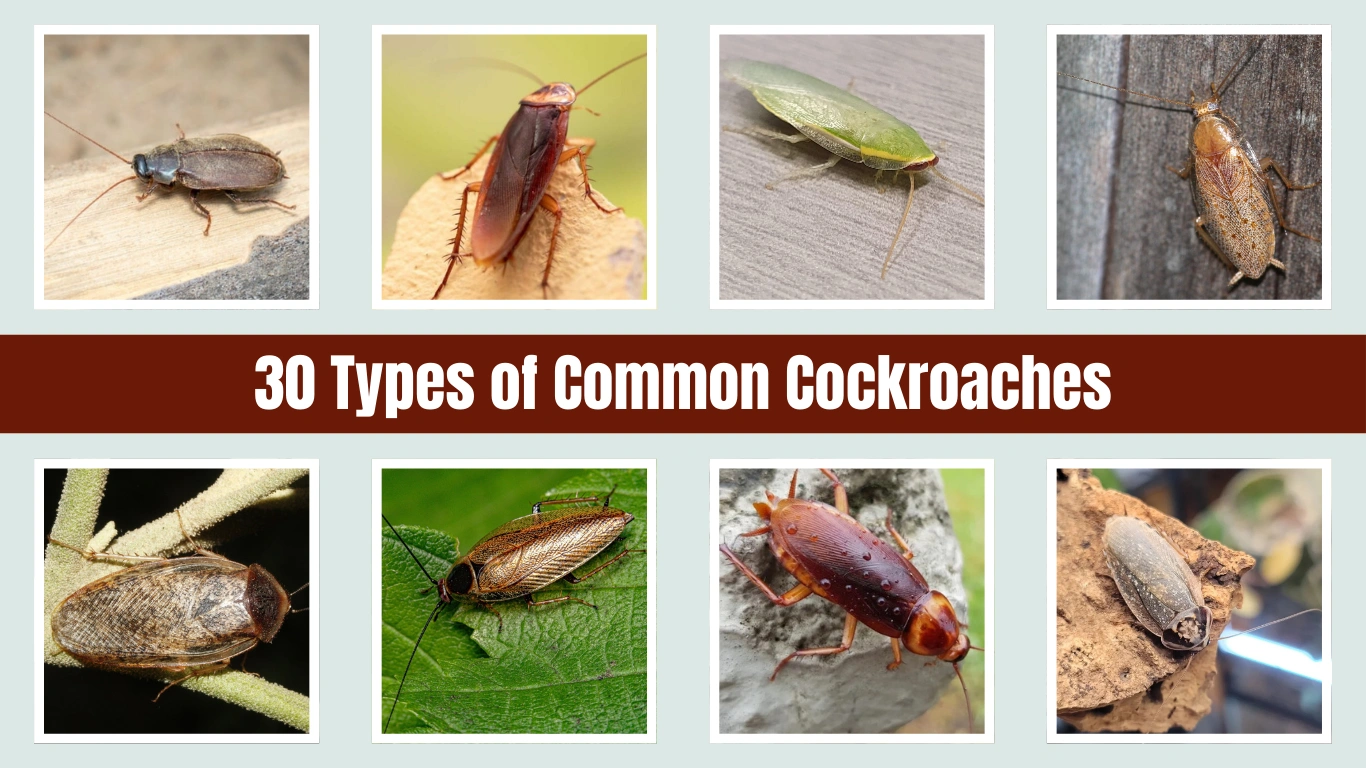
Cockroaches are among the most adaptable insects in the world, thriving in diverse environments from kitchens to gardens. While some species are notorious household pests, others live quietly outdoors, playing a role in nature’s recycling process. Identifying cockroaches is essential for understanding their behavior, habitats, and the risks they may pose. In this guide, we explore 30 types of common cockroaches, covering their key traits, diets, and hidden places where they often nest.
1. German Cockroach
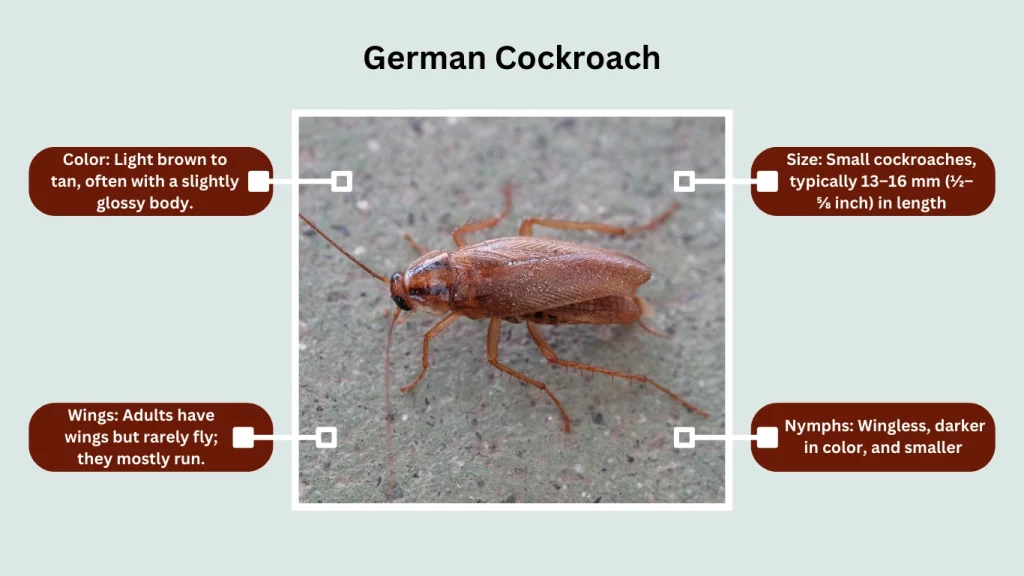
The German cockroach (Blattella germanica) is considered the most widespread cockroach species in the world. Unlike some outdoor cockroaches, this species almost exclusively lives indoors, making it a serious household pest. They multiply extremely quickly — a single female can produce up to 300–400 offspring in her lifetime — which is why infestations spread fast if not controlled early.
Identification
- Color: Light brown to tan, often with a slightly glossy body.
- Distinct Markings: Two bold, dark parallel stripes running lengthwise on the pronotum (shield-like structure behind the head).
- Size: Small cockroaches, typically 13–16 mm (½–⅝ inch) in length, which makes them smaller than American or Oriental cockroaches.
- Wings: Adults have wings but rarely fly; they mostly run.
- Nymphs: Wingless, darker in color, and smaller but still show the characteristic stripes.
Habitat
German cockroaches prefer warm, humid, and enclosed environments. They are almost always found indoors, especially in places where food is prepared or stored. Kitchens, restaurants, hotels, hospitals, and apartment complexes are common hotspots. They squeeze into tiny cracks and crevices, often as narrow as 1.6 mm, making them hard to detect.
Behavior
German cockroaches are nocturnal, avoiding light and human activity during the day. They emerge at night to feed and move quickly, making them difficult to catch. Their rapid breeding cycle allows populations to explode within weeks. They also release pheromones that attract other cockroaches to their hiding spots, leading to clustered infestations.
Diet
They are omnivorous scavengers with a very broad diet. While they prefer starchy foods, meats, sweets, and greasy residues, they can survive on non-food substances such as soap, toothpaste, glue, and even book bindings. This adaptability ensures their survival even in less favorable conditions. They can live up to 2 weeks without water and up to 1 month without food.
Nest / Hidden Place
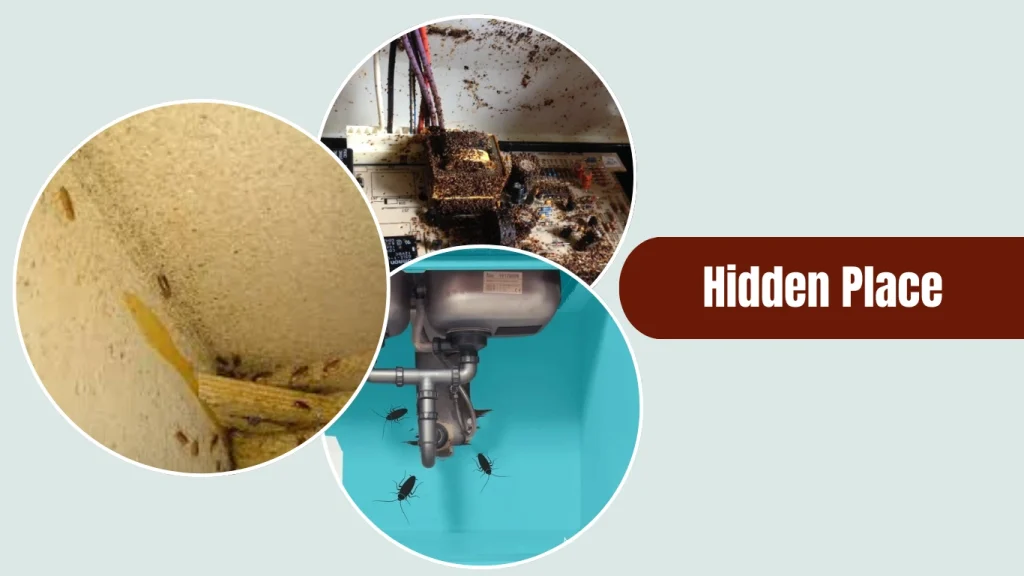
German cockroaches are masters of concealment. They often nest in:
- Crevices behind kitchen appliances (refrigerators, ovens, microwaves)
- Inside cupboard hinges and drawers
- Around plumbing and sinks where moisture is present
- Cracks in walls, under baseboards, and in electrical outlets
They prefer to stay within a few feet of food and water sources, rarely traveling far, which makes kitchens and bathrooms their prime territory.
2. American Cockroach
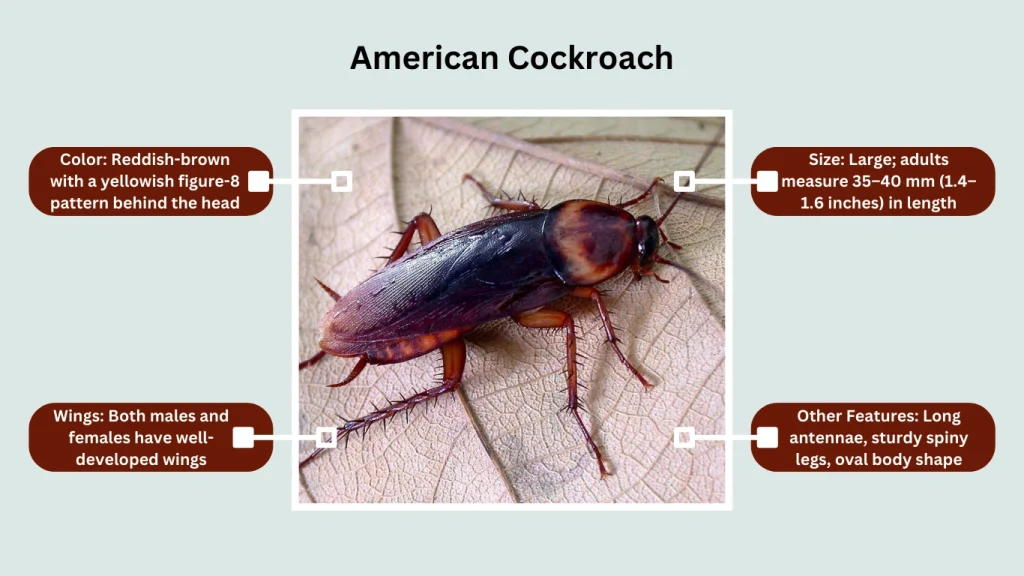
The American cockroach (Periplaneta americana) is one of the largest common household cockroach species. Despite its name, it is believed to have originated in Africa and was introduced to the Americas in the 1600s. Known for its size and ability to fly short distances, this cockroach is often found in warm, damp environments such as basements, sewers, and boiler rooms.
Identification
- Color: Reddish-brown with a yellowish figure-8 pattern behind the head
- Size: Large; adults measure 35–40 mm (1.4–1.6 inches) in length
- Wings: Both males and females have well-developed wings; capable of gliding or flying short distances
- Nymphs: Wingless, grayish-brown, and gradually develop the reddish hue with age
- Other Features: Long antennae, sturdy spiny legs, oval body shape
Habitat
American cockroaches thrive in warm, dark, and moist environments. They are often found in basements, sewer systems, boiler rooms, crawl spaces, and drainage pipes. Outdoors, they can be seen in mulch piles, woodpiles, and near garbage areas. Unlike German cockroaches, they tolerate outdoor conditions more easily.
Behavior
This species is highly active and known for its strong running speed. American cockroaches are scavengers and can travel long distances in search of food and water. They prefer temperatures above 70°F (21°C) and will migrate indoors during colder months. They are also capable of gliding or flying, especially in warm climates. Their presence often signals unsanitary conditions, as they are frequent in sewers.
Diet
American cockroaches are opportunistic feeders, consuming almost anything organic. Their diet includes decaying matter, food scraps, crumbs, pet food, paper, fabrics, and even dead insects. They are also attracted to fermented liquids and can survive several weeks without food but only a few days without water.
Nest / Hidden Place
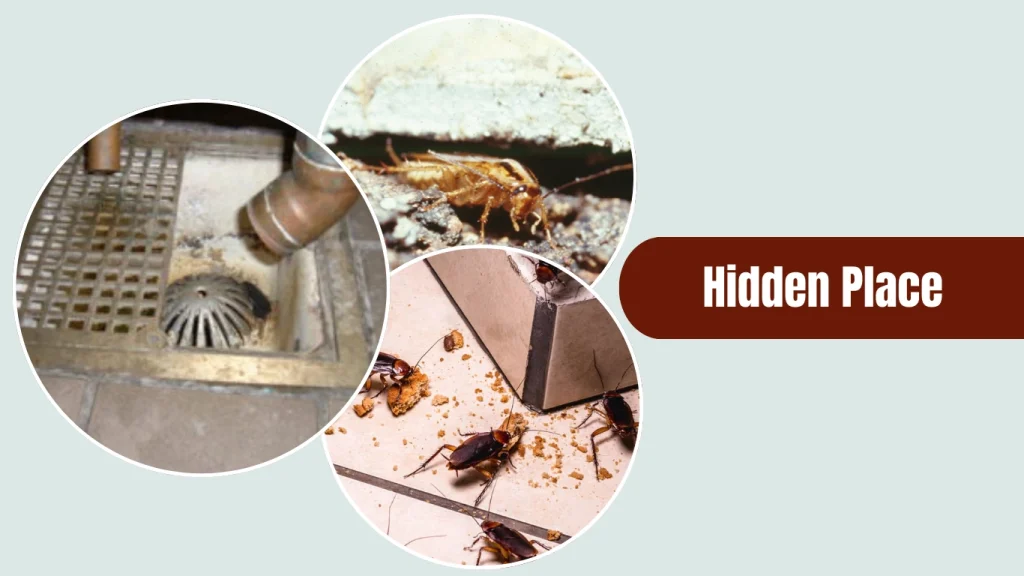
They typically hide in dark, moist, and sheltered areas. Common nesting sites include:
- Cracks and crevices in basements
- Sewer and drainage pipes
- Beneath appliances and sinks
- Storage boxes and cardboard piles
- Damp crawl spaces and boiler rooms
American cockroaches tend to form groups and release aggregation pheromones, drawing more roaches to the same hiding spots.
3. Oriental Cockroach
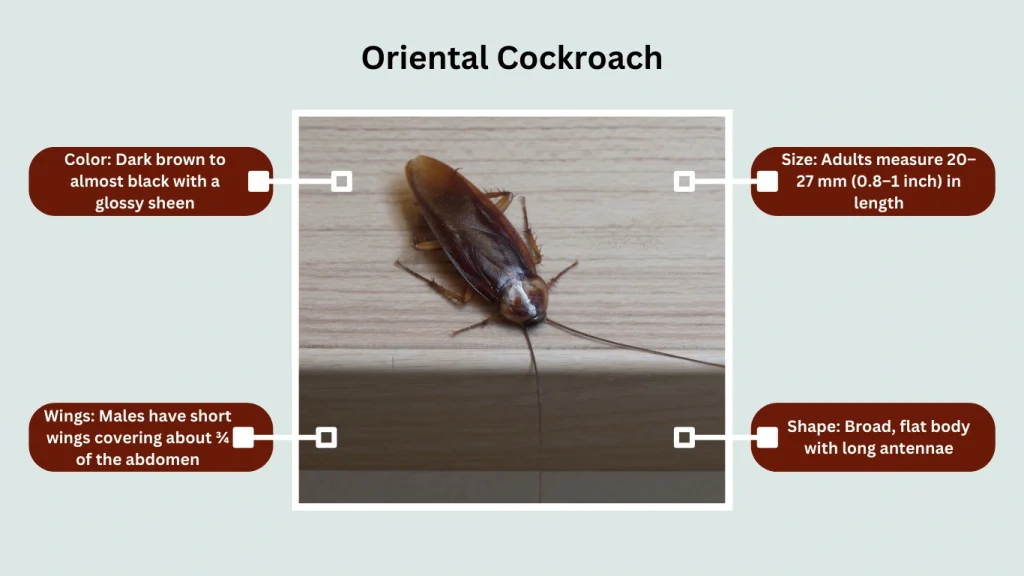
The Oriental cockroach (Blatta orientalis), sometimes called the “water bug” or “black beetle cockroach,” is known for its dark, shiny appearance and preference for cool, damp environments. It is slower than other species and is often found in basements, drains, and sewers. Oriental cockroaches are considered one of the dirtiest species because they frequently feed on decaying matter and garbage.
Identification
- Color: Dark brown to almost black with a glossy sheen
- Size: Adults measure 20–27 mm (0.8–1 inch) in length
- Wings: Males have short wings covering about ¾ of the abdomen; females have tiny, almost vestigial wings and cannot fly
- Shape: Broad, flat body with long antennae
- Nymphs: Small, wingless, and dark brown to black
Habitat
Oriental cockroaches thrive in cool, damp, and dark environments. They are often found in basements, crawl spaces, sewers, drains, and under sinks. Outdoors, they prefer hiding under leaf litter, mulch, and stones. Unlike German or American cockroaches, they are more tolerant of cooler climates.
Behavior
Oriental cockroaches are slow movers compared to other species. They are nocturnal, hiding during the day and coming out at night to search for food. They produce a strong, unpleasant odor, especially when infestations are large. Their movement between sewers and kitchens makes them a serious carrier of pathogens.
Diet
They are scavengers that feed on a wide range of decaying organic matter. Their diet includes garbage, rotting food, fecal matter, plant debris, and starchy household items. They are less likely than German cockroaches to eat non-food items but still adapt when food is scarce.
Nest / Hidden Place
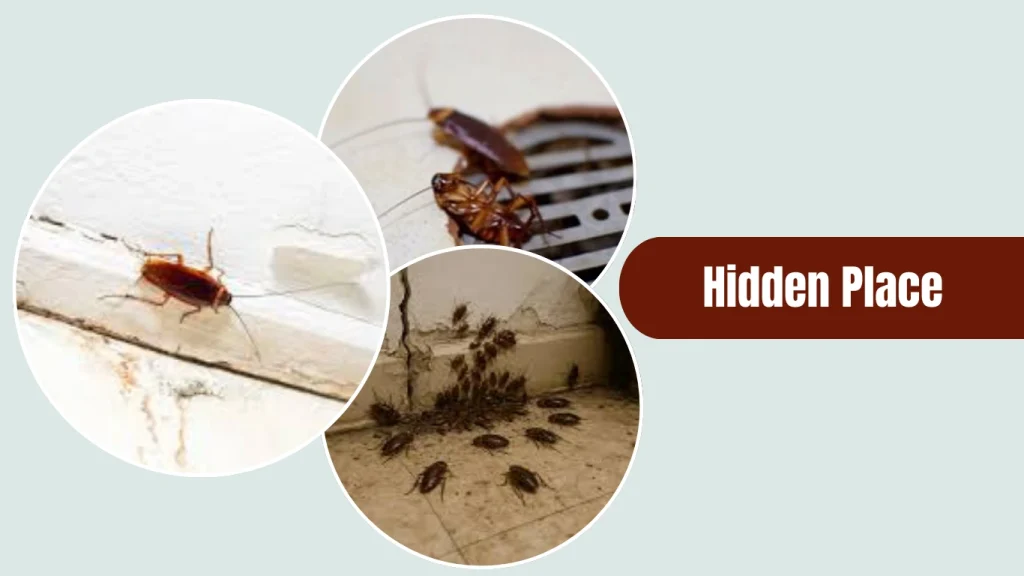
Oriental cockroaches usually nest in cool, damp, and hidden areas such as:
- Floor drains and sewer pipes
- Cracks in basements and foundations
- Moist crawl spaces
- Under sinks, washing machines, and leaky pipes
- Outdoors in compost heaps, under rocks, and garden debris
They prefer to stay near moisture sources and are often associated with unsanitary environments.
4. Brown-Banded Cockroach
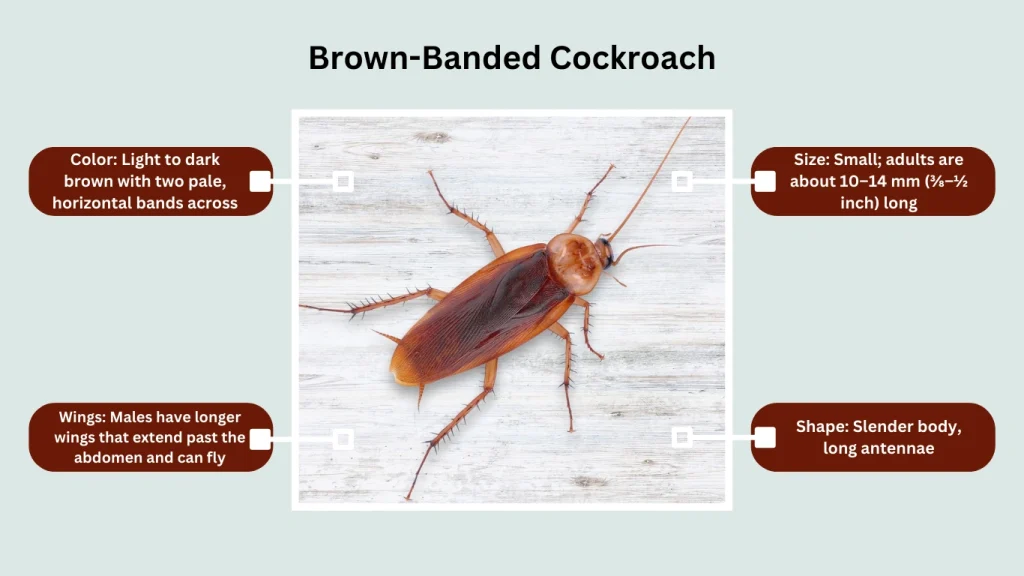
The Brown-banded cockroach (Supella longipalpa) is a small but widespread indoor species. Unlike German cockroaches, they prefer drier and warmer areas of buildings and are commonly found in upper cabinets, furniture, and electronic devices. They get their name from the light brown bands running across their wings and abdomen.
Identification
- Color: Light to dark brown with two pale, horizontal bands across the wings and abdomen
- Size: Small; adults are about 10–14 mm (⅜–½ inch) long
- Wings: Males have longer wings that extend past the abdomen and can fly; females have shorter wings and rarely fly
- Shape: Slender body, long antennae
- Nymphs: Darker in color, with visible pale bands across their abdomen
Habitat
Brown-banded cockroaches prefer warmer, drier areas compared to other species. They are often found higher up in rooms, unlike German cockroaches which stay near kitchens and bathrooms. Typical hiding spots include upper cabinets, behind picture frames, inside furniture, and even electronics like televisions and computers.
Behavior
This species is more dispersed than others, spreading throughout entire buildings rather than clustering in kitchens. They are nocturnal but may be seen during the day if disturbed. Unlike Oriental cockroaches, they do not require much moisture and often inhabit areas far from water sources. They reproduce quickly, though not as fast as German cockroaches.
Diet
Brown-banded cockroaches are omnivores and feed on a wide variety of materials, including starchy foods, wallpaper paste, book bindings, fabrics, glues, and household crumbs. They are known to damage non-food items such as clothing and paper when food is scarce.
Nest / Hidden Place

Their nests are often located in dry, elevated, and concealed places such as:
- Behind wall decorations and clocks
- Inside furniture and upholstery
- Electrical appliances and wiring spaces
- Closets and drawers
- Upper corners of rooms and ceilings
They prefer secluded areas away from kitchens and bathrooms, making them harder to detect early in an infestation.
5. Smokybrown Cockroach
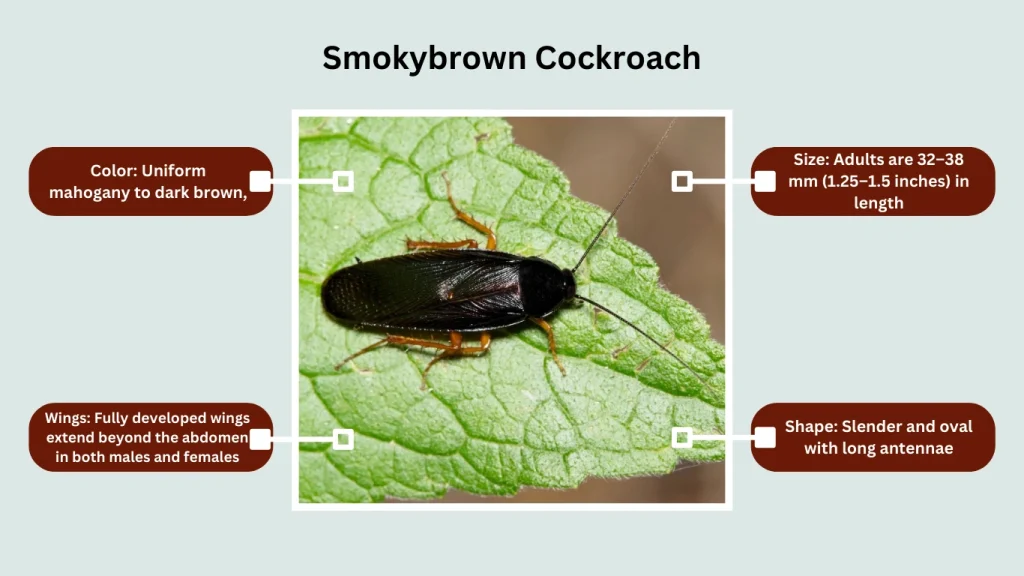
The Smokybrown cockroach (Periplaneta fuliginosa) is a large species closely related to the American cockroach. It is known for its uniform dark, smoky-brown color and shiny appearance. Smokybrown cockroaches are strong fliers and are often found in warm, humid outdoor environments, though they can invade homes in search of food and water.
Identification
- Color: Uniform mahogany to dark brown, glossy body without distinctive markings
- Size: Adults are 32–38 mm (1.25–1.5 inches) in length
- Wings: Fully developed wings extend beyond the abdomen in both males and females; capable of flight
- Shape: Slender and oval with long antennae
- Nymphs: Black in early stages, turning reddish-brown as they mature
Habitat
Smokybrown cockroaches thrive in warm, humid outdoor environments. They are commonly found in tree holes, mulch piles, gutters, woodpiles, and greenhouses. When indoors, they prefer attics, basements, and areas with poor ventilation. Because they dehydrate easily, they stay close to moisture sources.
Behavior
They are nocturnal and remain hidden during the day. Smokybrown cockroaches are excellent climbers and fliers, often attracted to lights at night. They are more dependent on water than some other species, so they are usually found near damp areas. They are known for their ability to infest outdoor vegetation and then move indoors, especially in warm climates.
Diet
Smokybrown cockroaches are scavengers and will eat almost any organic matter, including plant materials, fruits, pet food, garbage, and decaying vegetation. They can also consume paper and other cellulose-based products when food is scarce. Their strong attraction to sweets and starches makes human food a major target.
Nest / Hidden Place
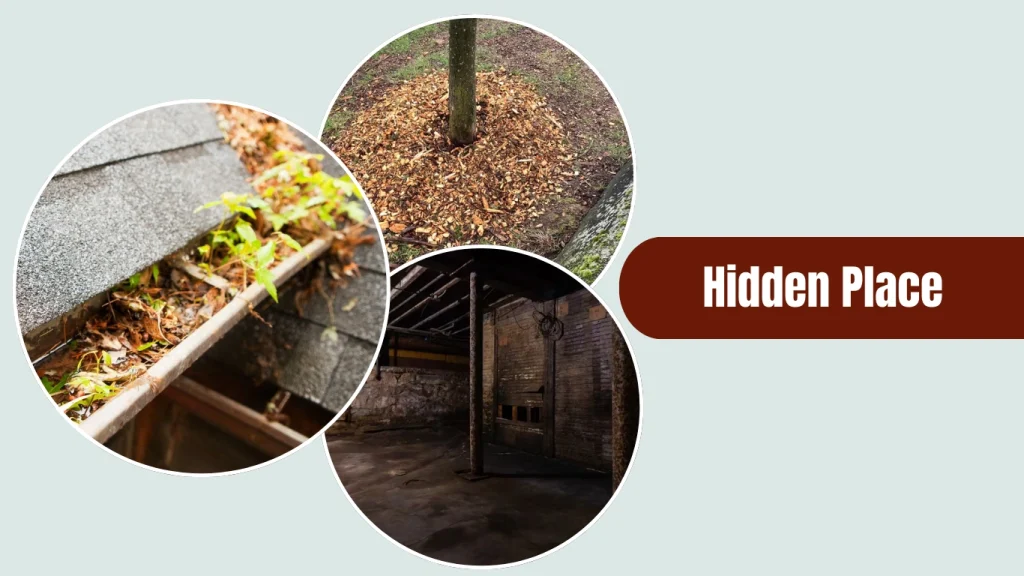
They usually nest in humid, dark, and protected areas, such as:
- Tree hollows and mulch beds outdoors
- Clogged gutters and roof shingles
- Basements, attics, and wall voids indoors
- Cracks in exterior walls and near leaky pipes
- Woodpiles and compost heaps
Their need for high humidity means they rarely survive long in dry indoor areas unless water sources are nearby.
6. Australian Cockroach
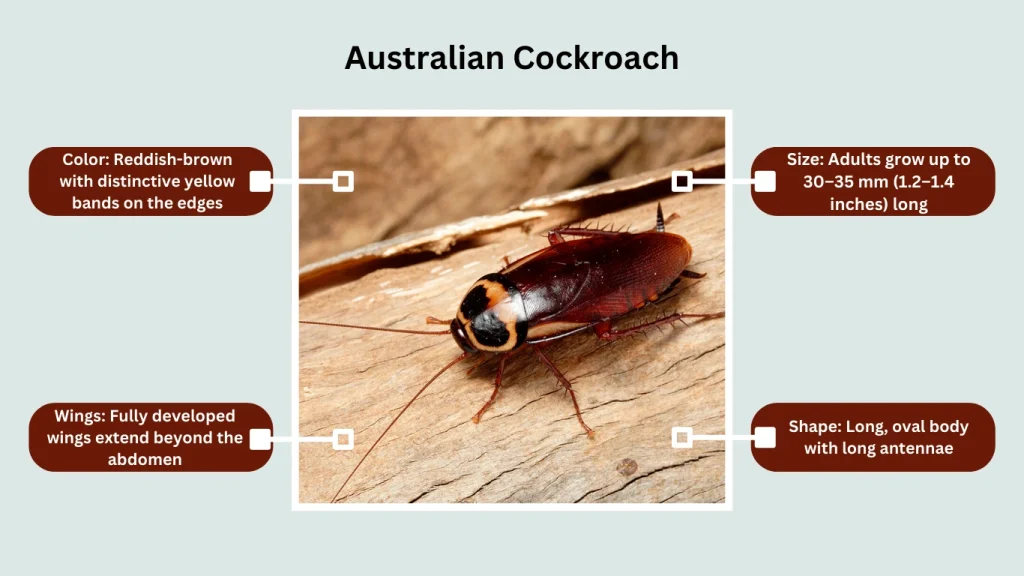
The Australian cockroach (Periplaneta australasiae) is often mistaken for the American cockroach due to its similar size and reddish-brown body. However, it can be distinguished by the yellow markings on its thorax and wings. Despite its name, it is not native to Australia—it is believed to have originated in Africa but is now found in tropical and subtropical regions worldwide.
Identification
- Color: Reddish-brown with distinctive yellow bands on the edges of the forewings and a yellow outline around the pronotum
- Size: Adults grow up to 30–35 mm (1.2–1.4 inches) long
- Wings: Fully developed wings extend beyond the abdomen; capable of flight
- Shape: Long, oval body with long antennae
- Nymphs: Darker in color with yellowish markings developing as they mature
Habitat
Australian cockroaches prefer warm, humid climates and are mostly outdoor dwellers. They are commonly found in gardens, greenhouses, woodpiles, mulch beds, and under tree bark. Indoors, they may be seen in basements, attics, and around plumbing areas, especially when outdoor conditions are unfavorable.
Behavior
They are nocturnal and avoid light, remaining hidden during the day. Australian cockroaches are fast runners and capable of flying short distances. They are more adapted to plant-based food sources compared to other cockroach species. Infestations often begin outdoors and spread indoors when food, warmth, or water becomes scarce.
Diet
Australian cockroaches are omnivorous but have a stronger preference for decaying plant matter, leaves, fruits, vegetables, and other organic material. They will also feed on household food scraps, starchy products, and paper. Their attraction to greenery makes them common pests in greenhouses and nurseries.
Nest / Hidden Place
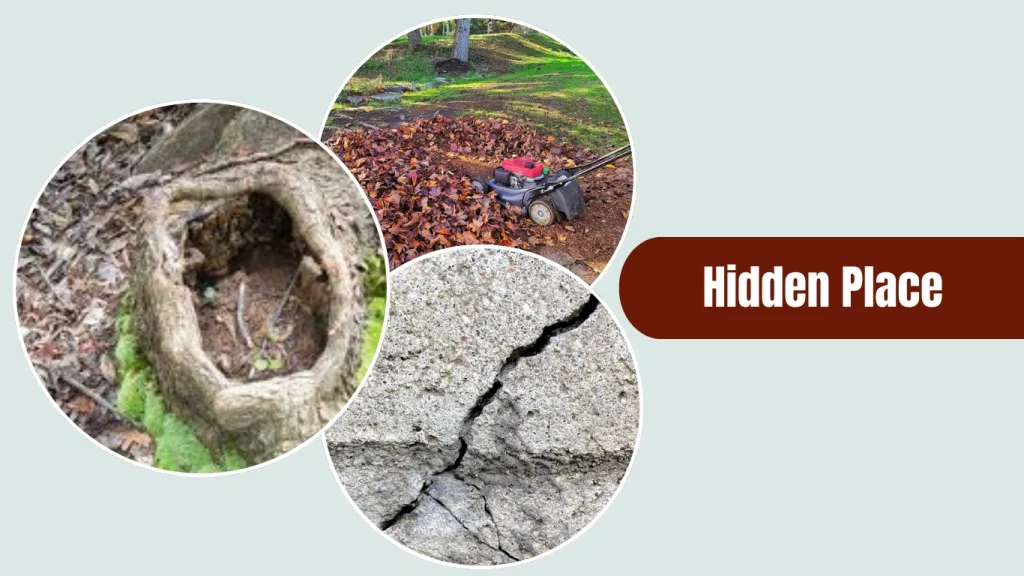
Their nests are usually outdoors but can extend indoors when conditions allow. Common hiding places include:
- Beneath mulch and leaf litter in gardens
- Tree hollows and under bark
- Cracks in walls, attics, and basements
- Around leaky plumbing and damp corners indoors
- Greenhouses and garden sheds
They prefer areas that provide moisture, warmth, and shelter, often nesting near vegetation or damp structures.
7. Asian Cockroach
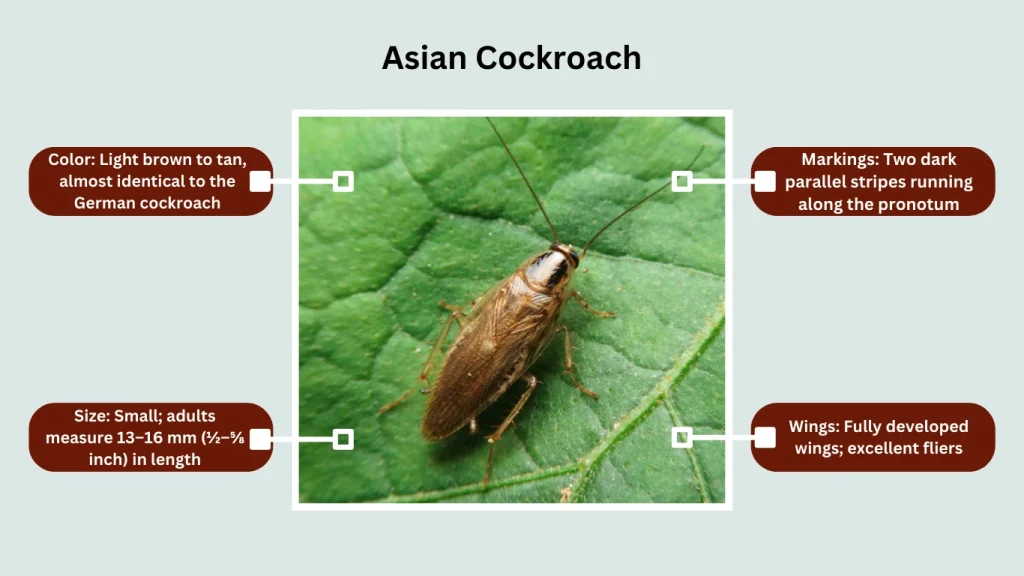
The Asian cockroach (Blattella asahinai) is a small species that closely resembles the German cockroach but differs in behavior and habitat. First identified in Japan, it has spread to many parts of Asia and also appeared in the United States. Unlike most cockroaches, Asian cockroaches are strong fliers and are often attracted to light, making them more noticeable around homes and gardens at night.
Identification
- Color: Light brown to tan, almost identical to the German cockroach
- Markings: Two dark parallel stripes running along the pronotum
- Size: Small; adults measure 13–16 mm (½–⅝ inch) in length
- Wings: Fully developed wings; excellent fliers
- Difference from German Cockroach: Asian cockroaches are stronger fliers and more commonly found outdoors, while Germans mostly infest indoors
Habitat
Asian cockroaches prefer outdoor habitats with plenty of greenery. They are often found in lawns, gardens, fields, and leaf litter. Indoors, they are less common but may fly inside, attracted to lights. They thrive in warm, moist environments and are often found near vegetation and organic debris.
Behavior
Unlike most cockroach species, Asian cockroaches are highly attracted to light and will fly toward lamps, windows, and television screens at night. They are strong fliers, capable of covering large distances. They do not typically cluster indoors but may accidentally invade homes. Their behavior makes them more of a nuisance pest than a serious indoor infestation threat.
Diet
They are omnivorous with a preference for decaying plant matter, leaves, grass clippings, and seeds. They will also feed on household crumbs and food scraps if they enter homes. Their attraction to outdoor vegetation makes them significant pests in gardens and agricultural areas.
Nest / Hidden Place

Asian cockroaches usually nest in moist, shaded outdoor environments, including:
- Leaf litter and mulch beds
- Tall grasses and ground covers
- Garden soil near plants
- Beneath outdoor debris and compost piles
- Occasionally inside homes near windows or doorways when attracted by lights
Their reliance on outdoor vegetation distinguishes them from their close relative, the German cockroach.
8. Surinam Cockroach
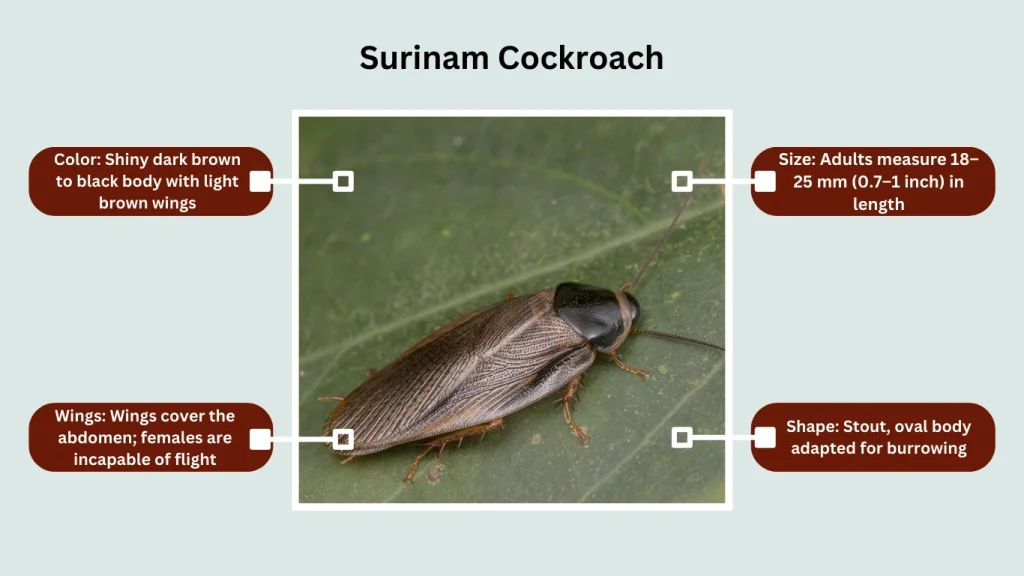
The Surinam cockroach (Pycnoscelus surinamensis) is a burrowing species commonly associated with soil and potted plants. Unlike many cockroaches, this species is parthenogenetic, meaning females can reproduce without males. As a result, infestations can grow quickly, with populations made up almost entirely of females. They are primarily outdoor pests but can invade homes through soil, mulch, or potted plants.
Identification
- Color: Shiny dark brown to black body with light brown wings
- Size: Adults measure 18–25 mm (0.7–1 inch) in length
- Wings: Wings cover the abdomen; females are incapable of flight
- Shape: Stout, oval body adapted for burrowing
- Nymphs: Black, wingless, and smaller, resembling beetles
Habitat
Surinam cockroaches prefer warm, moist soil and are frequently found in gardens, flowerbeds, compost piles, and potted plants. They thrive in tropical and subtropical climates. Indoors, they may be introduced through infested potted plants or mulch.
Behavior
These cockroaches are primarily burrowers, spending most of their lives in soil or leaf litter. They are nocturnal and emerge at night to forage. Being parthenogenetic, a single female can establish a new colony without males. Their populations tend to remain close to their nesting soil rather than spreading widely indoors.
Diet
Surinam cockroaches are omnivores but primarily consume decaying organic matter, roots, seedlings, and other plant materials. This feeding behavior makes them a garden and greenhouse pest, as they can damage young plants and roots.
Nest / Hidden Place
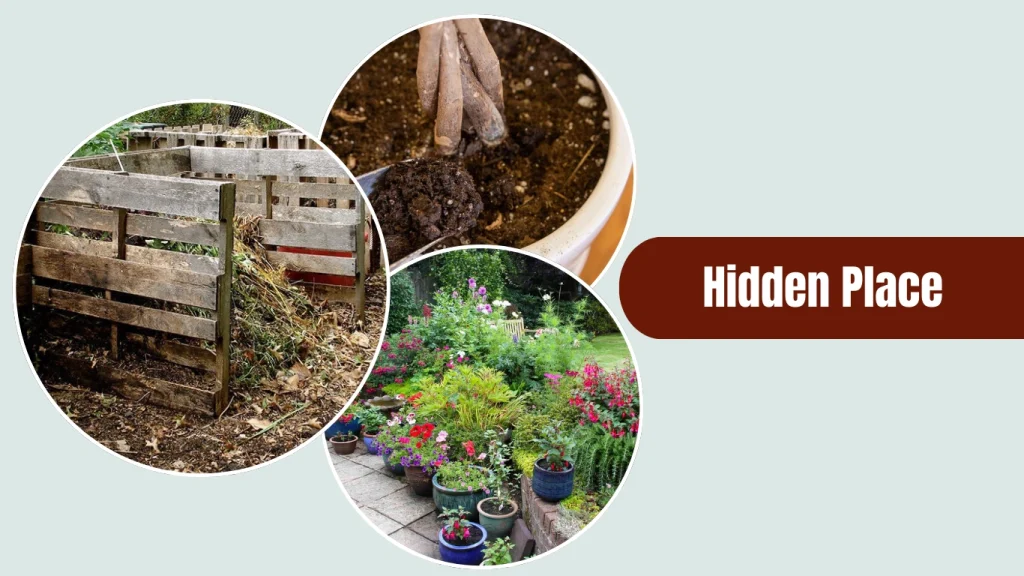
Their nests are usually located in moist soil environments, including:
- Potted plant soil indoors
- Compost piles and mulch beds outdoors
- Garden beds and flowerpots
- Soil beneath stones, boards, and garden debris
- Damp greenhouses and nurseries
They remain hidden in soil burrows during the day and only emerge at night, making them difficult to detect until plant damage or infestation signs appear.
9. Florida Woods Cockroach
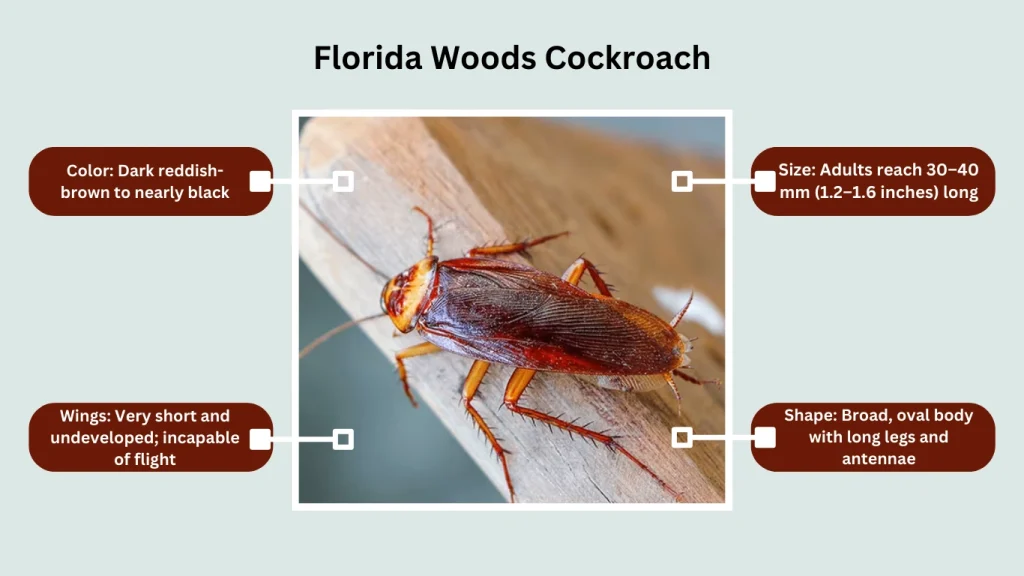
The Florida Woods cockroach (Eurycotis floridana), also called the Palmetto bug or Stinking cockroach, is a large species native to the southeastern United States, especially Florida. It is well known for producing a foul-smelling chemical spray as a defense mechanism. Unlike many cockroach species, it is slow-moving and less likely to infest homes in large numbers.
Identification
- Color: Dark reddish-brown to nearly black
- Size: Adults reach 30–40 mm (1.2–1.6 inches) long
- Wings: Very short and undeveloped; incapable of flight
- Shape: Broad, oval body with long legs and antennae
- Nymphs: Similar in appearance but smaller, with no wing stubs
Habitat
Florida Woods cockroaches are primarily outdoor dwellers, thriving in warm, humid, and shaded environments. They are commonly found in rotting logs, tree holes, mulch piles, under palmetto leaves, and around compost heaps. They may enter homes but usually prefer to remain outdoors.
Behavior
This species is slow-moving compared to other cockroaches. When threatened, it releases a strong, unpleasant chemical spray that repels predators. They are nocturnal scavengers, active at night and hiding during the day. Florida Woods cockroaches do not reproduce as rapidly as German cockroaches, so infestations indoors are less common.
Diet
They feed mainly on decaying organic matter, including fallen leaves, rotting wood, fungi, and garden debris. Occasionally, they may consume household scraps if they wander indoors. Their diet helps recycle nutrients in natural ecosystems.
Nest / Hidden Place
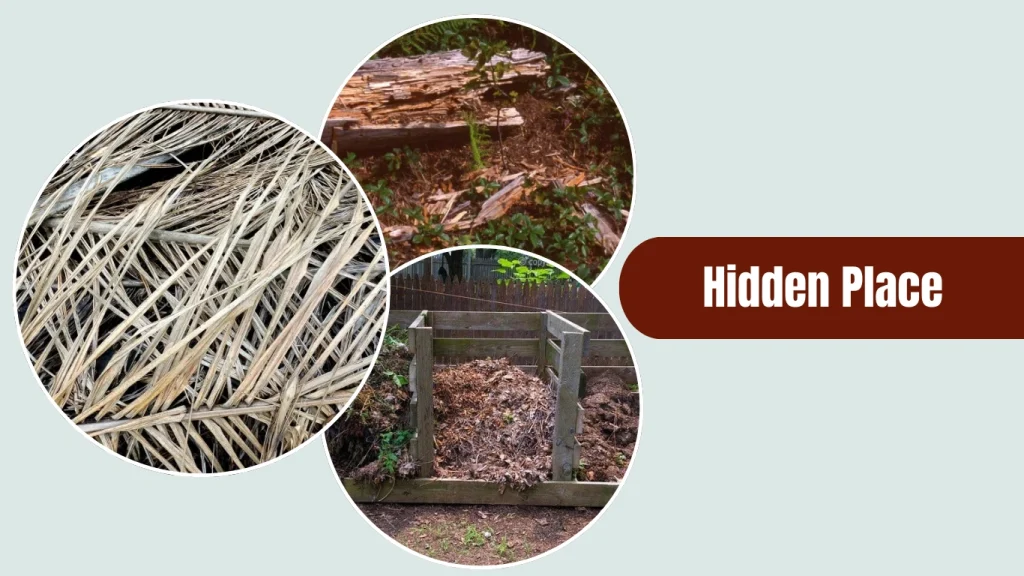
Florida Woods cockroaches usually nest in outdoor damp and decaying sites, such as:
- Rotting tree stumps and logs
- Under piles of leaves or palmetto fronds
- In mulch and compost heaps
- Beneath outdoor debris or firewood piles
- Occasionally in basements or garages with high humidity
Their preference for outdoor habitats and slower reproduction make them more of a nuisance pest than a major household threat.
10. Pennsylvania Wood Cockroach
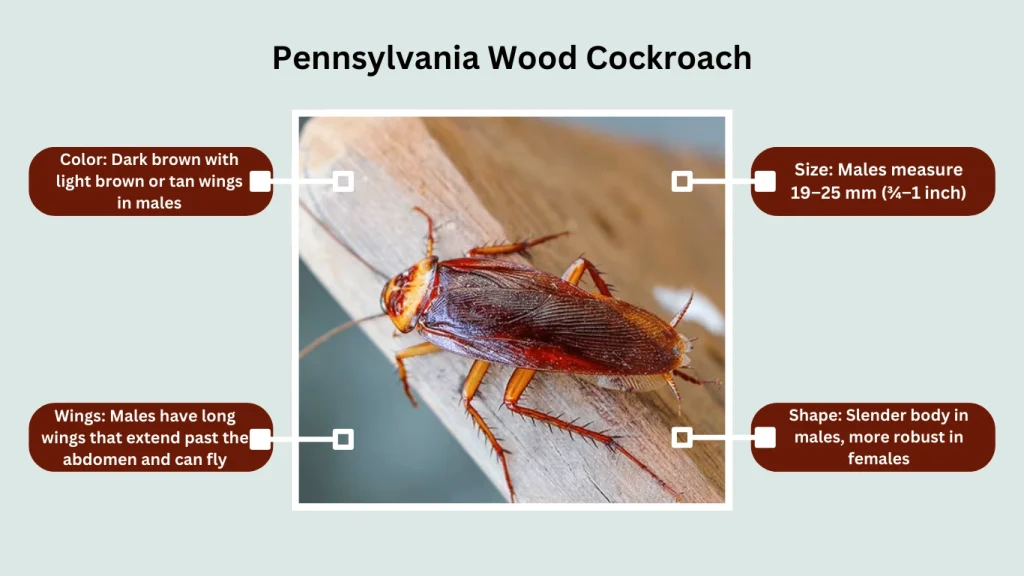
The Pennsylvania Wood cockroach (Parcoblatta pennsylvanica) is a native North American species commonly found in wooded areas. Unlike many household cockroaches, this species is less of a pest indoors and is usually considered a nuisance invader rather than a major health risk. They are more active outdoors but can accidentally enter homes, especially those near forests.
Identification
- Color: Dark brown with light brown or tan wings in males
- Size: Males measure 19–25 mm (¾–1 inch); females are smaller and broader at 12–15 mm (½ inch)
- Wings: Males have long wings that extend past the abdomen and can fly; females have shorter wings and cannot fly
- Shape: Slender body in males, more robust in females
- Nymphs: Dark brown, wingless, and resemble adults in body shape
Habitat
Pennsylvania Wood cockroaches prefer wooded outdoor habitats. They are often found under loose bark, woodpiles, tree hollows, and decaying logs. Homes surrounded by forests are more likely to encounter them, especially when lights attract flying males during summer evenings.
Behavior
This species is not highly reproductive indoors and rarely establishes colonies inside houses. Males are attracted to lights and may fly into homes at night, while females and nymphs remain hidden outdoors. They are less secretive than other cockroaches and may be seen crawling in open areas.
Diet
Pennsylvania Wood cockroaches feed mainly on decaying organic matter, bark, and leaf litter. Outdoors, they play a role in breaking down plant material. Indoors, they may nibble on household crumbs but generally do not infest kitchens the way German or American cockroaches do.
Nest / Hidden Place
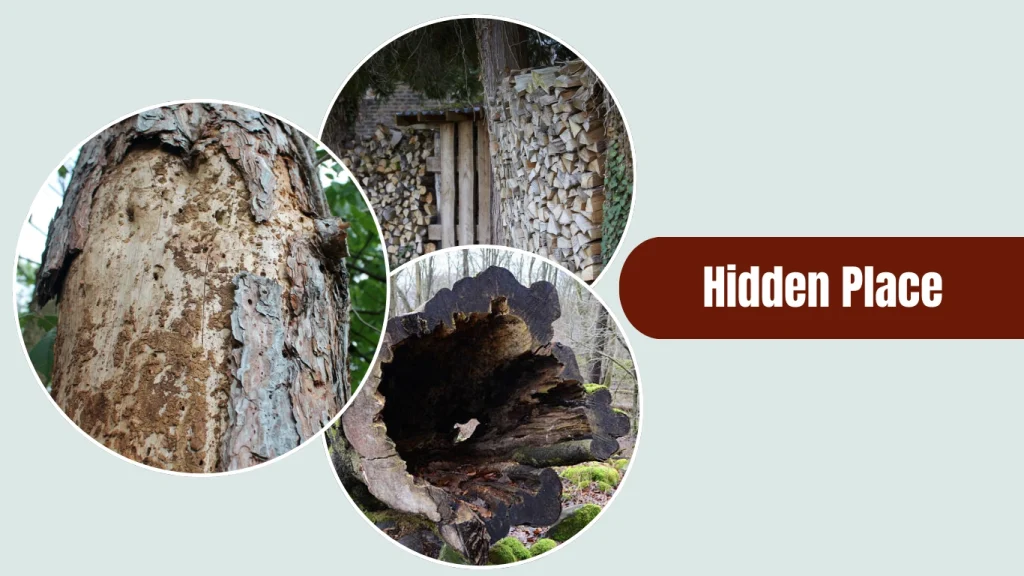
Their nests are almost always outdoors, typically in:
- Woodpiles and stacked firewood
- Beneath loose bark of dead trees
- Hollow logs and tree stumps
- Garden debris and leaf litter
- Occasionally in attics, basements, or garages when carried in with firewood
Because they do not thrive indoors, control usually involves reducing woodpiles and outdoor debris near homes rather than indoor treatments.
11. Cuban Cockroach
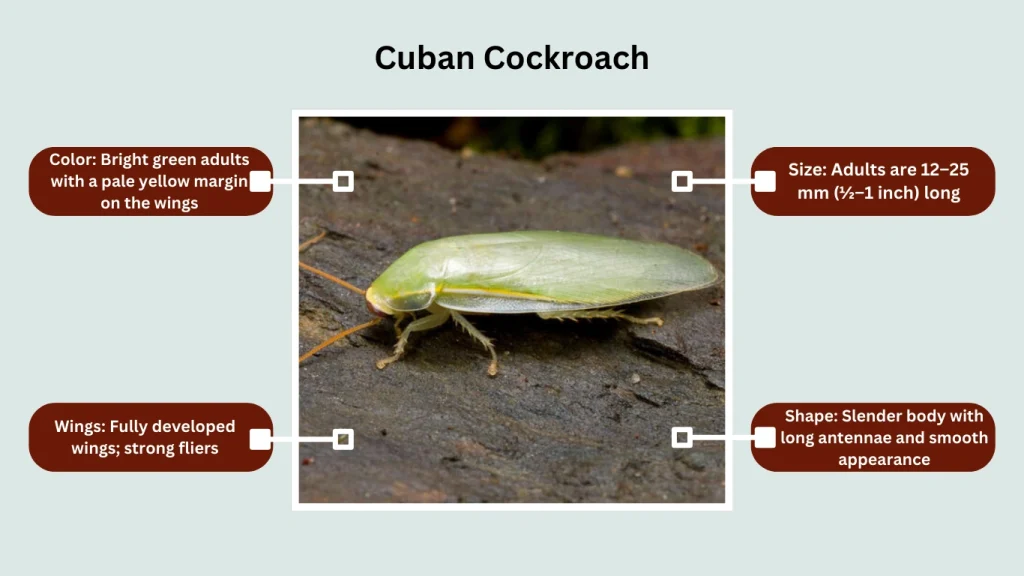
The Cuban cockroach (Panchlora nivea), also called the green cockroach, is a unique species known for its striking bright green color. Unlike most cockroaches, it is considered more of an outdoor insect and is not typically a household pest. Native to Cuba and the Caribbean, it has spread to parts of the southern United States, especially Florida and Texas.
Identification
- Color: Bright green adults with a pale yellow margin on the wings
- Size: Adults are 12–25 mm (½–1 inch) long
- Wings: Fully developed wings; strong fliers
- Nymphs: Brown to black and wingless, looking very different from adults
- Shape: Slender body with long antennae and smooth appearance
Habitat
Cuban cockroaches prefer warm, humid outdoor environments. They are commonly found in gardens, shrubs, trees, greenhouses, and outdoor vegetation. Indoors, they are rare but may accidentally enter homes, often attracted to lights at night.
Behavior
This species is nocturnal and strongly attracted to lights, which often brings them into contact with people. They are fast runners and excellent fliers, often seen fluttering around outdoor lights in the evening. Unlike pest cockroaches, Cuban cockroaches do not infest kitchens or reproduce indoors.
Diet
Their diet consists mainly of plant materials, including leaves, fruits, and decaying vegetation. They may also feed on organic debris in gardens. Because they are outdoor feeders, they pose little threat to stored household food.
Nest / Hidden Place
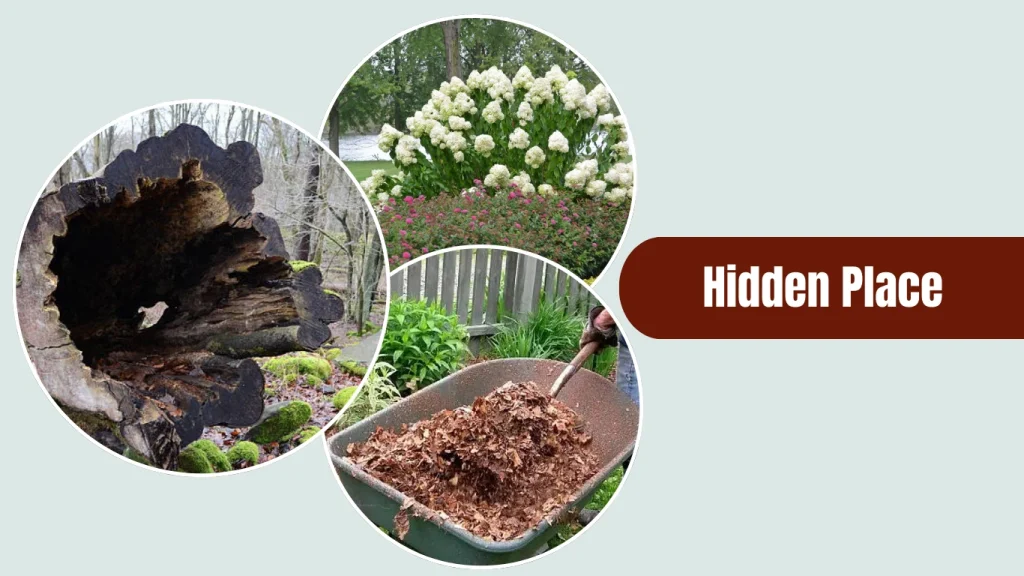
Cuban cockroaches nest in outdoor vegetation and moist debris, such as:
- Shrubs, hedges, and ornamental plants
- Tree bark and hollow logs
- Leaf litter and garden mulch
- Greenhouses and nurseries
- Occasionally near outdoor lights or porches where they are drawn at night
Their unusual green coloration makes them one of the most easily recognized cockroach species.
12. Turkestan Cockroach
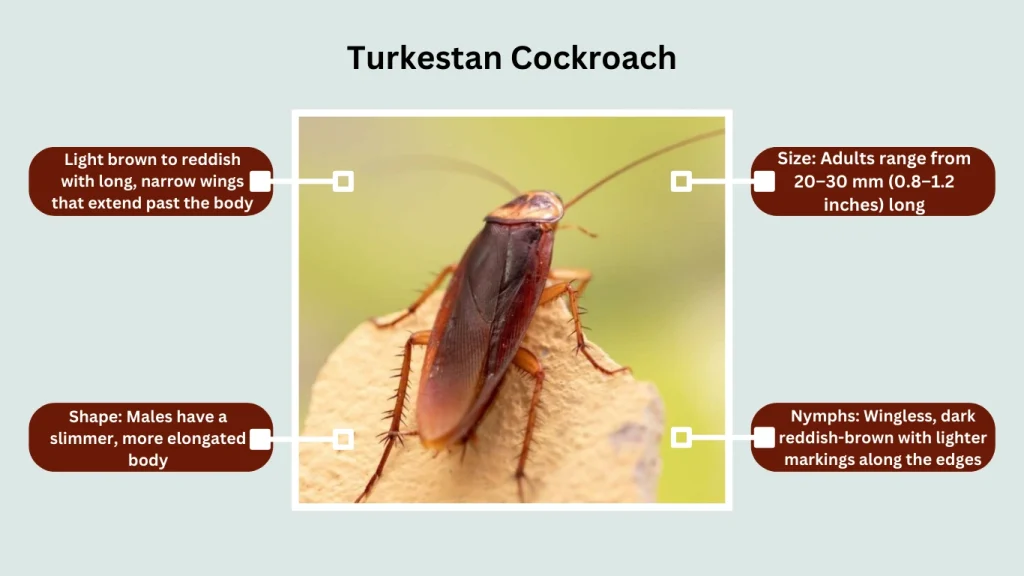
The Turkestan cockroach (Blatta lateralis) is an invasive species that has spread widely from its native range in Central Asia and the Middle East. It is especially common in the southwestern United States, where it has displaced some native cockroach species. Males and females look very different, making this species easy to identify once recognized.
Identification
- Color:
- Males: Light brown to reddish with long, narrow wings that extend past the body
- Females: Dark brown to black with shorter, rounded wings that do not cover the abdomen
- Males: Light brown to reddish with long, narrow wings that extend past the body
- Size: Adults range from 20–30 mm (0.8–1.2 inches) long
- Shape: Males have a slimmer, more elongated body; females are broader and heavier
- Nymphs: Wingless, dark reddish-brown with lighter markings along the edges
Habitat
Turkestan cockroaches prefer warm, dry, and dark environments, particularly outdoors. They are often found in sewers, storm drains, compost piles, leaf litter, and under stones or debris. Around buildings, they hide near foundations, cracks, and gaps, especially in poorly lit and damp areas.
Behavior
These cockroaches are nocturnal and emerge at night to feed. Males are active fliers and are attracted to lights, often entering homes or buildings accidentally. Females, being flightless, remain closer to the ground and hiding places. Their adaptability and rapid reproduction make them a growing pest in urban areas.
Diet
Turkestan cockroaches are scavengers and feed on a variety of organic matter, including crumbs, food scraps, decaying vegetation, pet food, and garbage. Outdoors, they consume plant debris and organic waste, helping them survive in less hospitable conditions.
Nest / Hidden Place
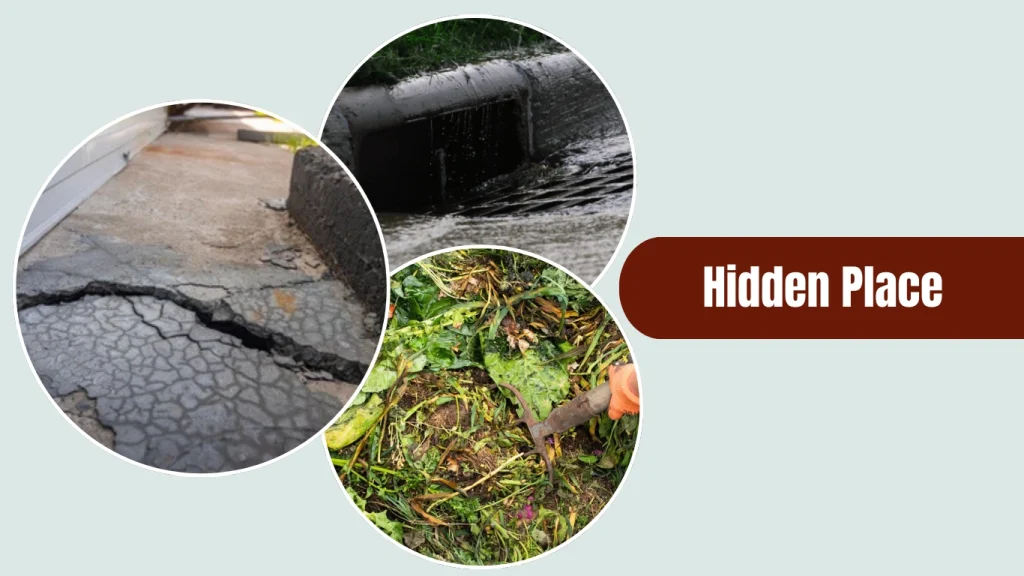
They nest in dark, damp crevices such as:
- Sewer systems and storm drains
- Cracks in sidewalks and building foundations
- Compost heaps and garden debris
- Under outdoor stones, logs, and firewood
- Utility boxes and irrigation systems
Their ability to thrive in urban outdoor environments makes them one of the most successful invasive cockroach species in recent years.
13. Madeira Cockroach
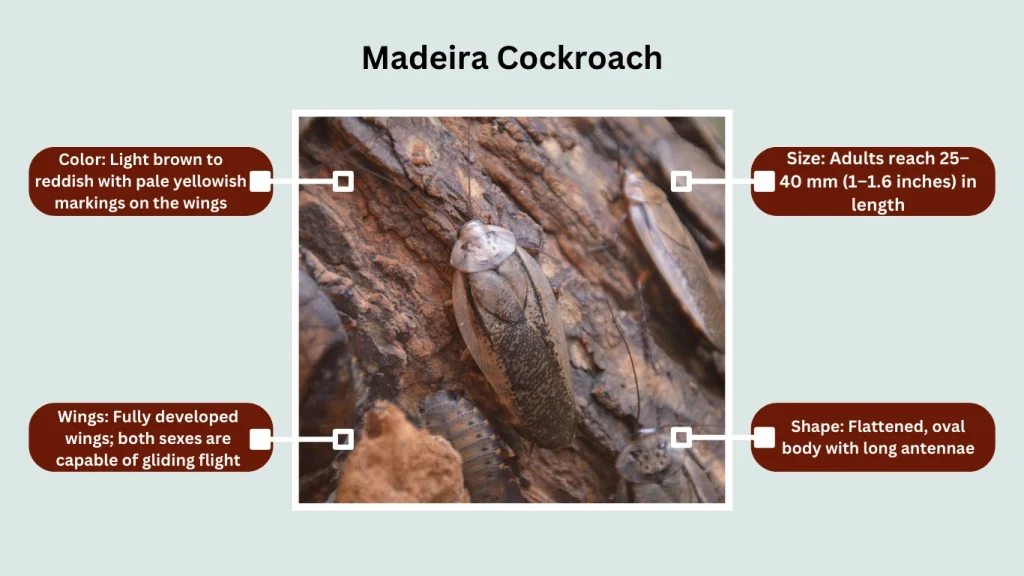
The Madeira cockroach (Rhyparobia maderae), sometimes called the harlequin cockroach, is a tropical species originally from the Canary Islands and Madeira but now spread across many warm regions worldwide. It is a large, attractive cockroach often kept by insect enthusiasts for study or as feeder insects for reptiles. Unlike German or American cockroaches, it rarely becomes a serious household pest.
Identification
- Color: Light brown to reddish with pale yellowish markings on the wings
- Size: Adults reach 25–40 mm (1–1.6 inches) in length
- Wings: Fully developed wings; both sexes are capable of gliding flight
- Shape: Flattened, oval body with long antennae
- Nymphs: Darker brown, wingless, and robust in shape
Habitat
Madeira cockroaches prefer warm, humid climates. Outdoors, they are often found in gardens, greenhouses, leaf litter, and decaying vegetation. Indoors, they may survive in basements, attics, and storage areas, especially in heated buildings within temperate regions.
Behavior
This species is nocturnal and generally avoids human contact. They are capable of gliding flight but usually prefer to crawl. Madeira cockroaches are not aggressive invaders like German cockroaches; infestations indoors are uncommon unless conditions are ideal. They are also known to be relatively docile, which is why they are sometimes bred for research or feeding pets.
Diet
They are omnivores with a diet consisting of decaying leaves, fruits, vegetables, plant debris, and household food scraps. In captivity, they are often fed fruits, grains, and vegetables. Their preference for organic matter makes them important recyclers in natural habitats.
Nest / Hidden Place
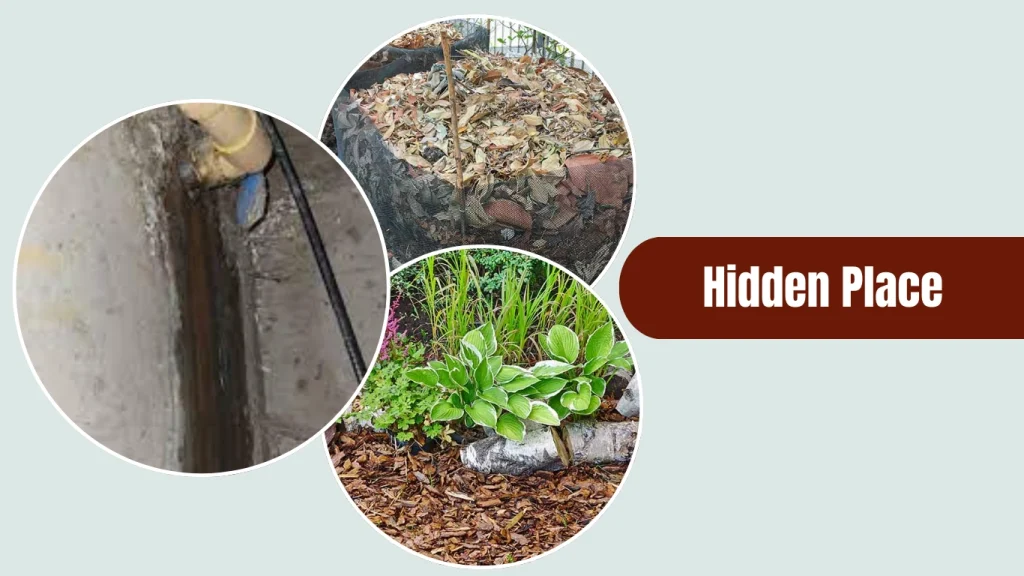
Madeira cockroaches typically hide in moist, sheltered areas, such as:
- Leaf litter and compost piles outdoors
- Cracks in walls and damp basements indoors
- Beneath stones, logs, and mulch
- Greenhouses and tropical plant soil
- Stored boxes and cluttered storage areas
Because they require warmth and humidity, they are more common in tropical and subtropical regions than in temperate climates.
14. Lobster Cockroach
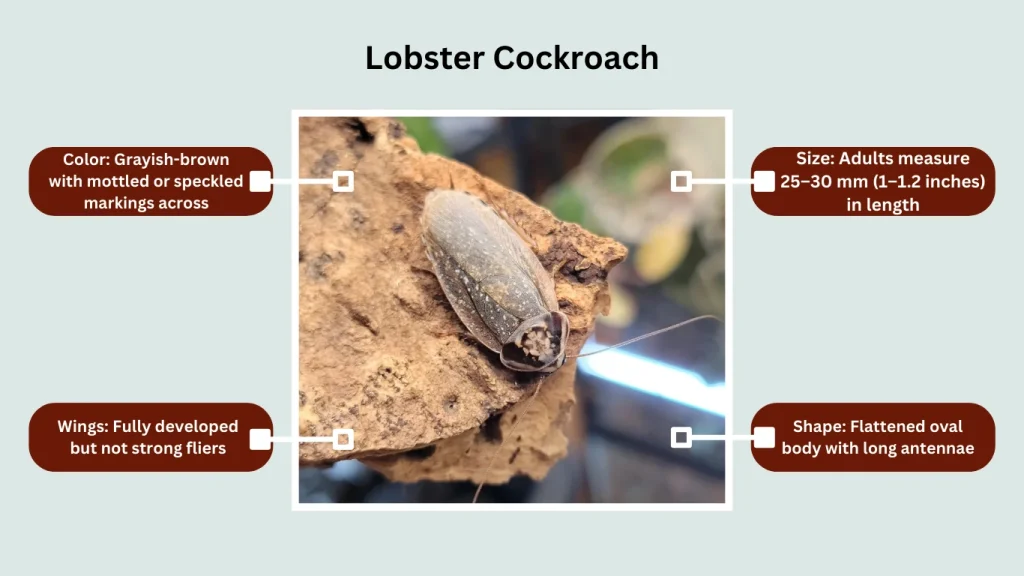
The Lobster cockroach (Nauphoeta cinerea), also known as the speckled cockroach or gray cockroach, is a medium-sized species originally from Africa but now found worldwide in warm regions. It is named “lobster” cockroach because of its resemblance to the coloration of a lobster’s shell. While it can infest buildings, it is also widely bred as feeder insects for reptiles and amphibians.
Identification
- Color: Grayish-brown with mottled or speckled markings across the thorax and wings
- Size: Adults measure 25–30 mm (1–1.2 inches) in length
- Wings: Fully developed but not strong fliers; they primarily crawl and glide short distances
- Shape: Flattened oval body with long antennae
- Nymphs: Dark brown to black, wingless, and smaller with a more robust body
Habitat
Lobster cockroaches prefer warm, moist, and dark environments. In the wild, they inhabit leaf litter, rotting logs, and decaying organic material. Indoors, they may establish themselves in basements, storage rooms, and damp crawl spaces. Because of their adaptability, they thrive in both natural and human-made environments.
Behavior
This species is nocturnal and avoids light, staying hidden during the day. It is a fast runner and reproduces quickly, making infestations difficult to control. Unlike German cockroaches, lobster cockroaches are less likely to cluster near kitchens but will spread to any warm and humid area. They emit a mild odor when disturbed, which helps deter predators.
Diet
Lobster cockroaches are scavengers, feeding on decaying organic matter, fruits, vegetables, grains, pet food, and household scraps. They can also consume paper and fabric products if food is limited. Their broad diet makes them highly adaptable in captivity and the wild.
Nest / Hidden Place
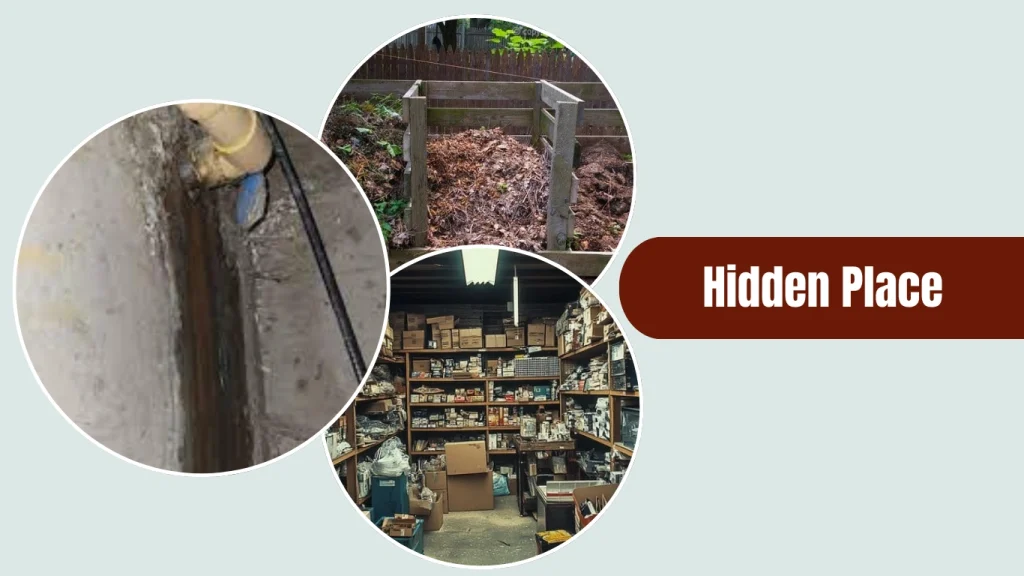
They typically nest in dark, concealed, and damp areas, such as:
- Leaf litter and mulch beds outdoors
- Cracks in basements and damp crawl spaces
- Behind stored boxes, clutter, and debris
- Inside rotting logs and compost piles
- Moist areas near plumbing indoors
Their adaptability, rapid reproduction, and strong survival skills make them a persistent pest in the right conditions.
15. Pale-Bordered Field Cockroach
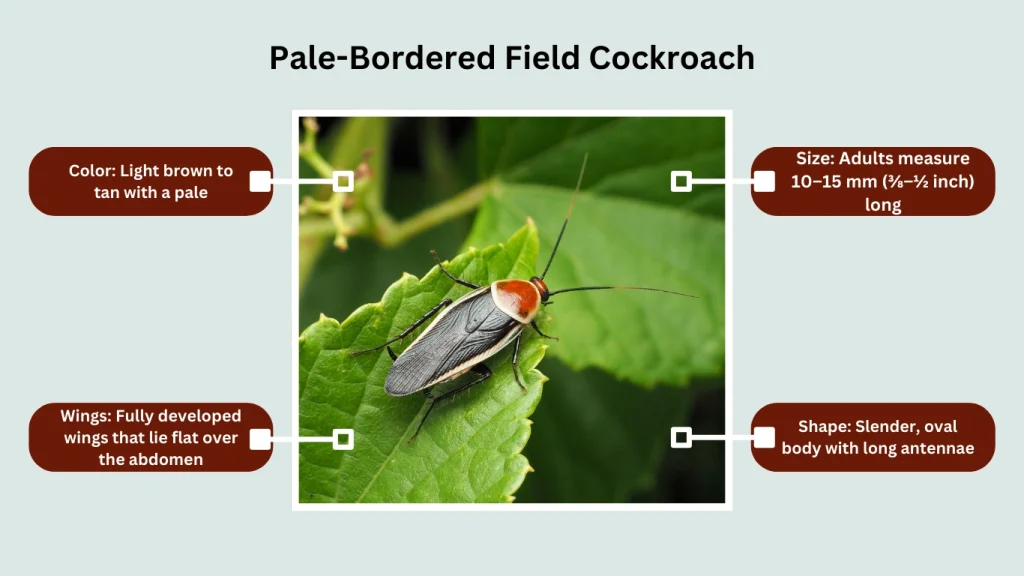
The Pale-borded field cockroach (Pseudomops septentrionalis) is a small outdoor species that is often mistaken for the German cockroach because of its size and markings. However, it is less of a household pest and is typically found in grassy or leafy environments. They are fast movers and can survive well in natural habitats without depending on human dwellings.
Identification
- Color: Light brown to tan with a pale, almost yellowish border along the wings
- Size: Adults measure 10–15 mm (⅜–½ inch) long
- Wings: Fully developed wings that lie flat over the abdomen; capable of short glides
- Shape: Slender, oval body with long antennae
- Nymphs: Darker brown, wingless, with faint pale markings appearing as they mature
Habitat
Pale-borded field cockroaches live mostly outdoors, preferring grassy areas, fields, gardens, and shrubbery. They are sometimes found near homes but rarely infest indoors permanently. They thrive in warm, slightly humid environments with plenty of vegetation.
Behavior
These cockroaches are active and fast-running, especially at night when they come out to forage. They are not strongly nocturnal like German cockroaches and may be seen during the day if disturbed. They are considered occasional invaders indoors, usually flying or crawling in through windows and doors but not reproducing inside.
Diet
Pale-borded field cockroaches are omnivorous scavengers, feeding primarily on decaying plant material, seeds, and small organic debris. Outdoors, they help recycle nutrients in soil and vegetation. Indoors, they may feed on crumbs or scraps but typically do not compete with pest species like the German cockroach.
Nest / Hidden Place
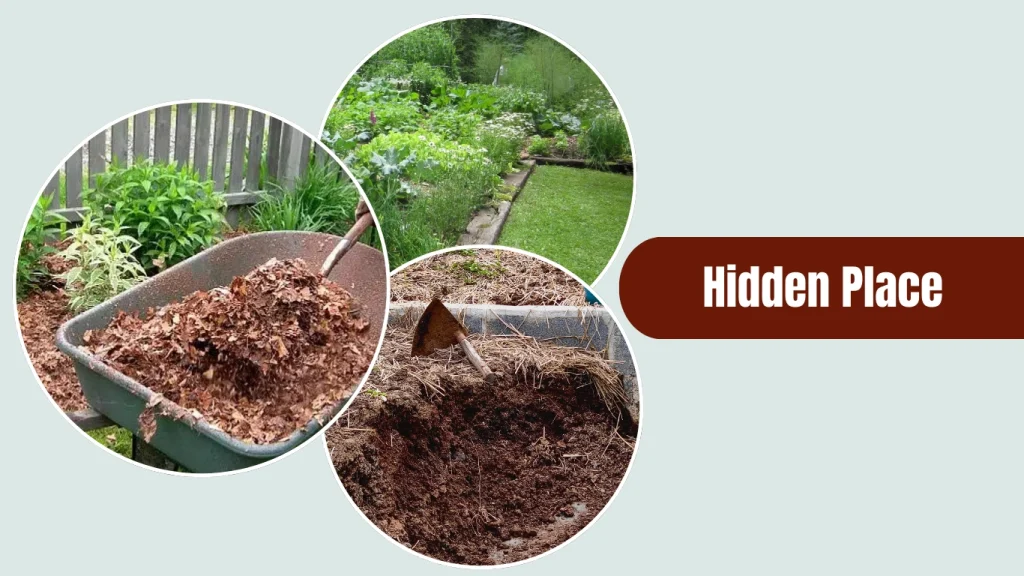
They usually nest in outdoor vegetation and soil, such as:
- Grass and shrubbery beds
- Leaf litter and mulch
- Garden soil and compost piles
- Cracks near outdoor foundations
- Occasionally in garages or sheds when attracted to light
Because they remain mostly outdoors, they are considered minor nuisance pests rather than significant indoor invaders.
16. Brown Cockroach
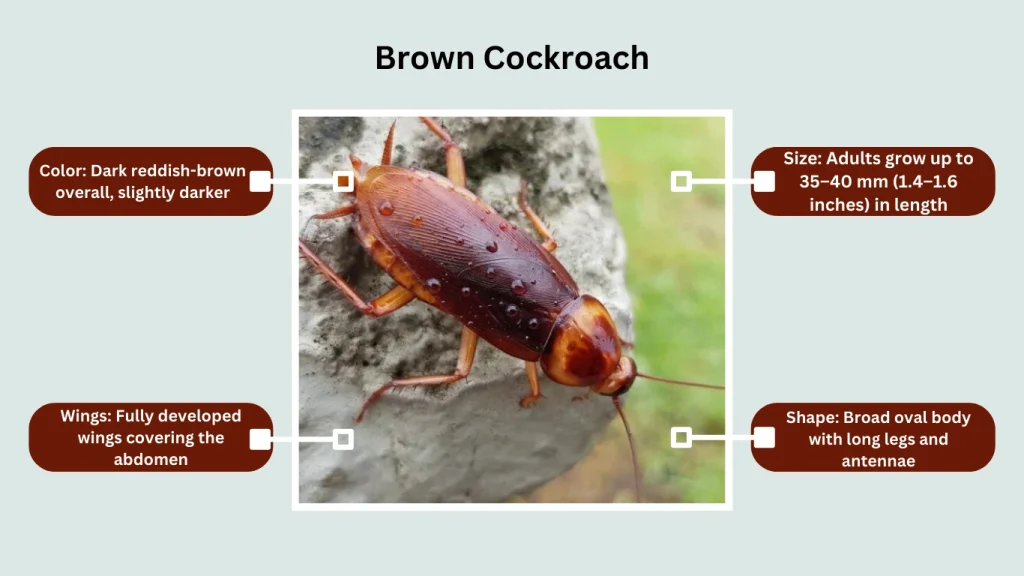
The Brown cockroach (Periplaneta brunnea) is a large species closely related to the American cockroach. It is less common but can be just as troublesome when it invades homes and buildings. Its reddish-brown coloration and large size often lead to it being mistaken for the American cockroach, but it can be distinguished by subtle differences in color and wing structure.
Identification
- Color: Dark reddish-brown overall, slightly darker than the American cockroach
- Size: Adults grow up to 35–40 mm (1.4–1.6 inches) in length
- Wings: Fully developed wings covering the abdomen; capable of gliding or short flights
- Shape: Broad oval body with long legs and antennae
- Nymphs: Wingless, dark brown, and more robust in body shape
Habitat
Brown cockroaches prefer warm, damp environments and are often found in basements, crawl spaces, boiler rooms, sewers, and around plumbing systems. Outdoors, they live in woodpiles, mulch, and decaying vegetation. They are more common in southern and subtropical climates.
Behavior
This species is nocturnal and avoids light, emerging at night to search for food and water. Like the American cockroach, they are fast runners and can startle people when disturbed. Brown cockroaches are strong survivors, often thriving in sewer systems and other unsanitary areas.
Diet
They are opportunistic feeders, consuming almost any organic material, including food scraps, garbage, pet food, paper products, and decaying plant matter. Their preference for human food waste makes them a significant pest in restaurants and food-storage areas.
Nest / Hidden Place
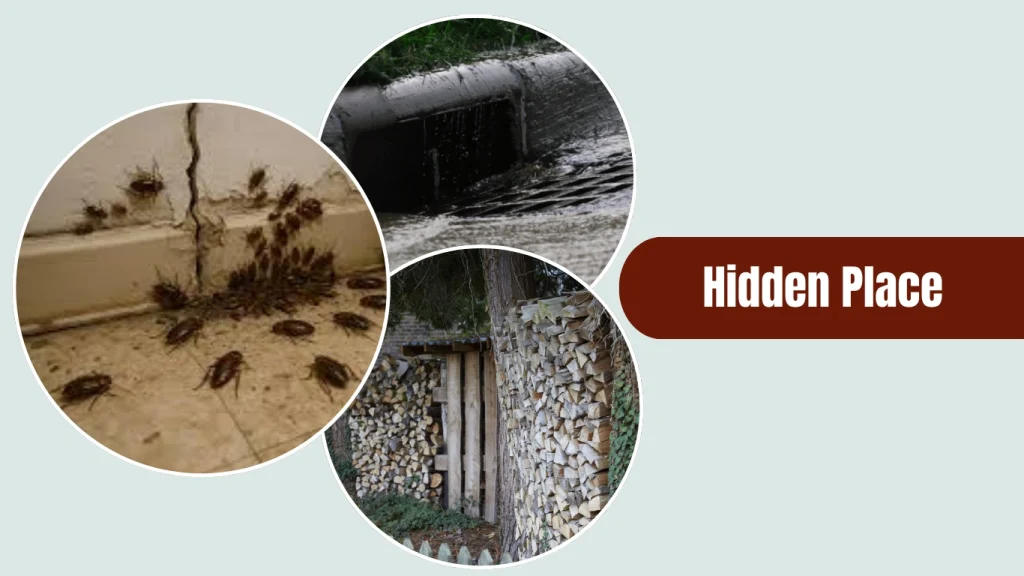
Brown cockroaches usually nest in dark, moist, and concealed spaces, such as:
- Sewer drains and manholes
- Cracks in basements and crawl spaces
- Around water heaters and plumbing areas
- Woodpiles, compost heaps, and mulch outdoors
- Under debris or garbage piles
Because of their size and strong odor, infestations of brown cockroaches can be especially unpleasant in residential and commercial spaces.
17. Sand Cockroach
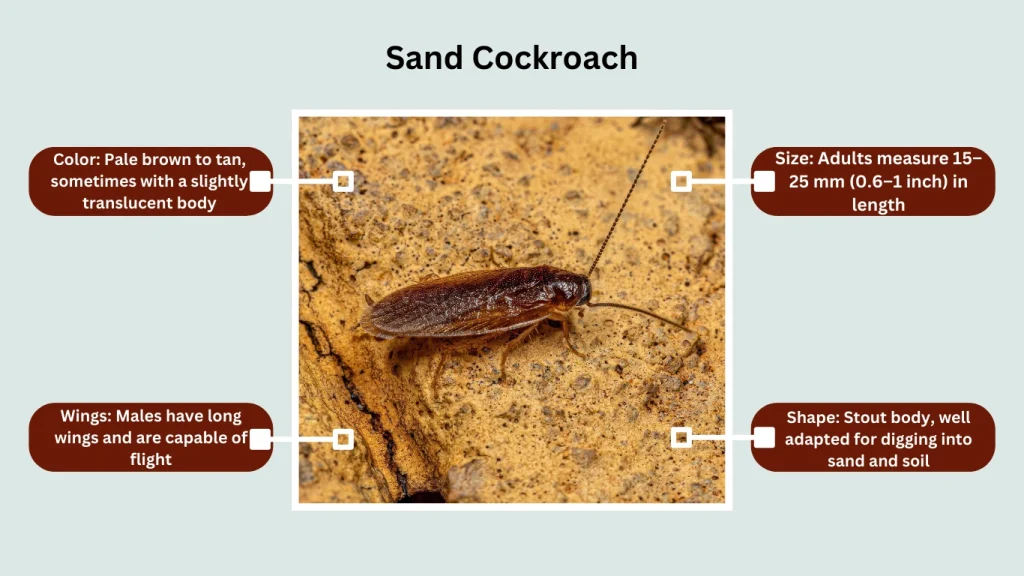
The Sand cockroach (Arenivaga spp.) is a group of burrowing cockroaches primarily found in arid and sandy regions. Unlike common household cockroaches, sand cockroaches are not considered pests and rarely invade human dwellings. They are adapted to desert environments and spend most of their lives underground.
Identification
- Color: Pale brown to tan, sometimes with a slightly translucent body
- Size: Adults measure 15–25 mm (0.6–1 inch) in length
- Wings: Males have long wings and are capable of flight; females are wingless and resemble beetles
- Shape: Stout body, well adapted for digging into sand and soil
- Nymphs: Wingless, smaller, and darker, living entirely underground
Habitat
Sand cockroaches are native to deserts and sandy soils, where they burrow to avoid the heat of the day. They are commonly found in dunes, dry grasslands, and sandy scrublands. Unlike pest cockroaches, they do not thrive in human environments.
Behavior
These cockroaches are nocturnal and emerge at night to forage. Males often fly in search of females, while females remain hidden underground. Sand cockroaches are non-invasive, shy, and rarely encountered by humans unless they are dug up or seen at night.
Diet
Sand cockroaches primarily feed on decaying plant matter, roots, seeds, and organic debris found in the soil. They play an important role in desert ecosystems by recycling nutrients.
Nest / Hidden Place
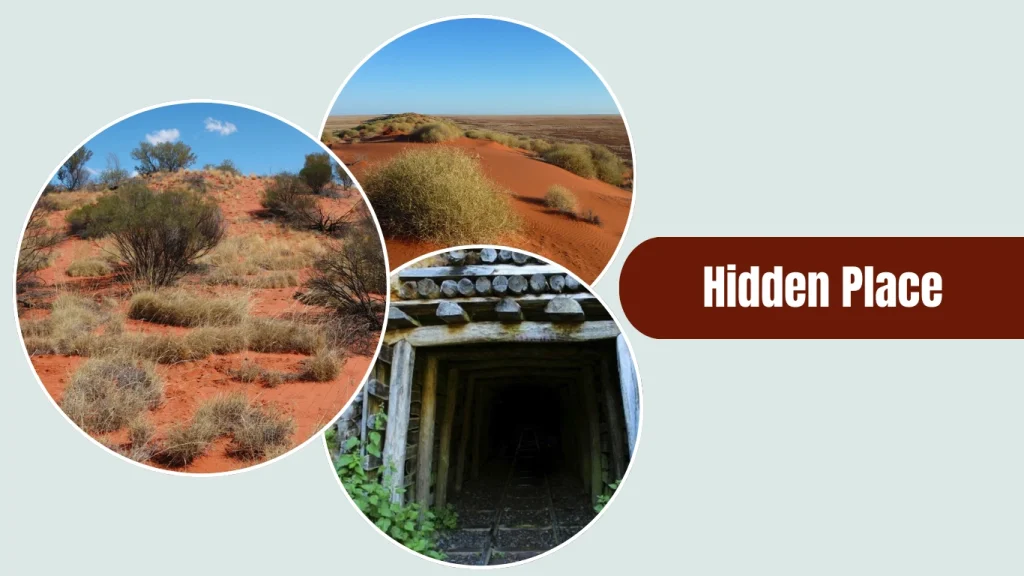
Their nests consist of underground burrows in sandy or loose soil, such as:
- Dry desert sands and dunes
- Beneath shrubs and desert vegetation
- Underground tunnels made by females for protection
- Soil beneath rocks or debris in arid areas
They remain hidden during the day and depend on burrows to maintain moisture in harsh desert climates.
18. Speckled Cockroach
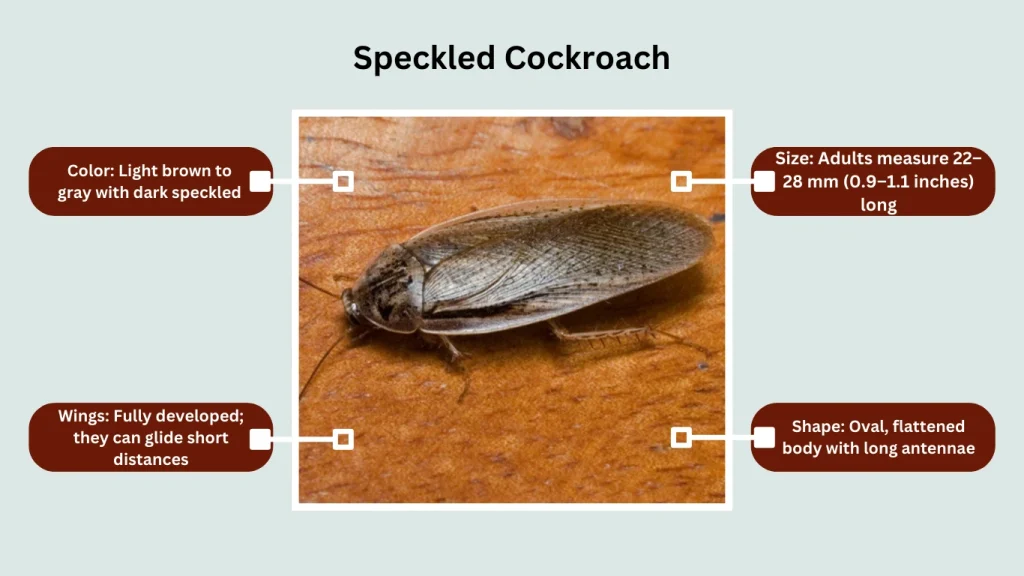
The Speckled cockroach (Nauphoeta cinerea), also called the speckled feeder cockroach, is closely related to the lobster cockroach and is often bred as a feeder insect for reptiles, amphibians, and birds. It is hardy and adaptable but not usually considered a major household pest.
Identification
- Color: Light brown to gray with dark speckled or mottled markings on the wings and thorax
- Size: Adults measure 22–28 mm (0.9–1.1 inches) long
- Wings: Fully developed; they can glide short distances but are not strong fliers
- Shape: Oval, flattened body with long antennae
- Nymphs: Darker brown, wingless, and more robust in build
Habitat
Speckled cockroaches prefer warm, humid environments and are often found in leaf litter, decaying vegetation, compost piles, and under debris. Indoors, they are less common but may survive in basements, damp crawl spaces, or storage areas.
Behavior
They are nocturnal scavengers, active mostly at night, and avoid light. The speckled cockroach is known for being fast-moving and reproducing quickly. It emits a mild odor when disturbed. Unlike German cockroaches, it does not typically cluster in kitchens but prefers damp, secluded areas.
Diet
They are omnivorous, feeding on decaying plant matter, fruits, grains, vegetables, and organic waste. They will also eat pet food and scraps when available. Their broad diet makes them easy to keep in captivity.
Nest / Hidden Place
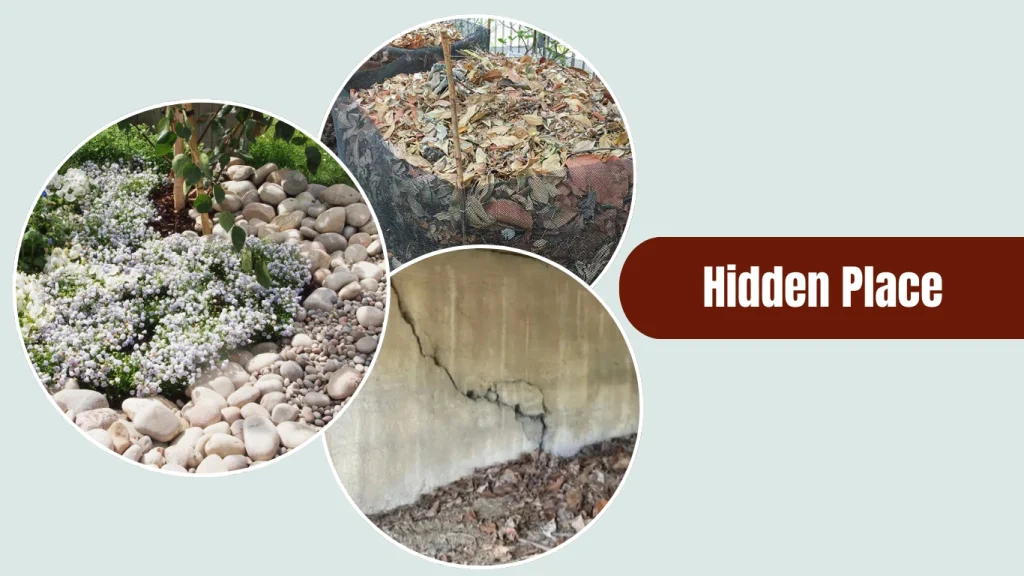
Speckled cockroaches usually nest in moist and concealed areas, including:
- Compost heaps and leaf litter outdoors
- Under logs, stones, or garden debris
- Cracks in basements or damp crawl spaces
- Stored boxes or cluttered storage areas
- Greenhouses and moist plant soil
They thrive in conditions with warmth and humidity, making them more common in tropical and subtropical regions.
19. Red-Headed Cockroach
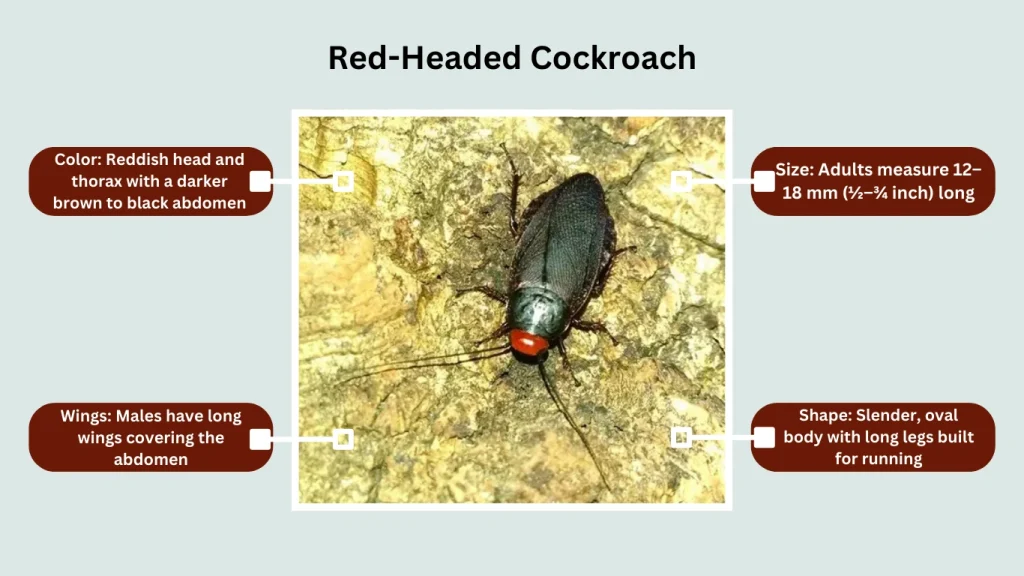
The Red-headed cockroach (Oxyhaloa deusta), sometimes called the red runner cockroach, is a small, fast-moving species originally from Africa but now established in many warm climates. It is commonly used as a feeder insect for reptiles and amphibians because of its rapid breeding and ease of care. Unlike German cockroaches, it does not usually infest kitchens or homes.
Identification
- Color: Reddish head and thorax with a darker brown to black abdomen
- Size: Adults measure 12–18 mm (½–¾ inch) long
- Wings: Males have long wings covering the abdomen; females have shorter wings and cannot fly
- Shape: Slender, oval body with long legs built for running
- Nymphs: Smaller, wingless, dark brown to black
Habitat
Red-headed cockroaches prefer warm, dry environments and are often found outdoors in leaf litter, under bark, in soil, and among debris. In captivity, they thrive in containers with dry substrate. Indoors, they rarely infest living spaces permanently but may wander in through cracks or gaps.
Behavior
They are extremely fast runners, earning them the nickname “red runners.” Males are capable of limited flight but prefer to run. These cockroaches are nocturnal and highly active at night. They reproduce quickly, with females producing egg cases that hatch into dozens of nymphs.
Diet
Red-headed cockroaches are omnivores, feeding on plant material, grains, fruits, vegetables, and small organic debris. In captivity, they are fed a mix of grains, fruits, and protein sources. Outdoors, they scavenge whatever organic matter they find.
Nest / Hidden Place
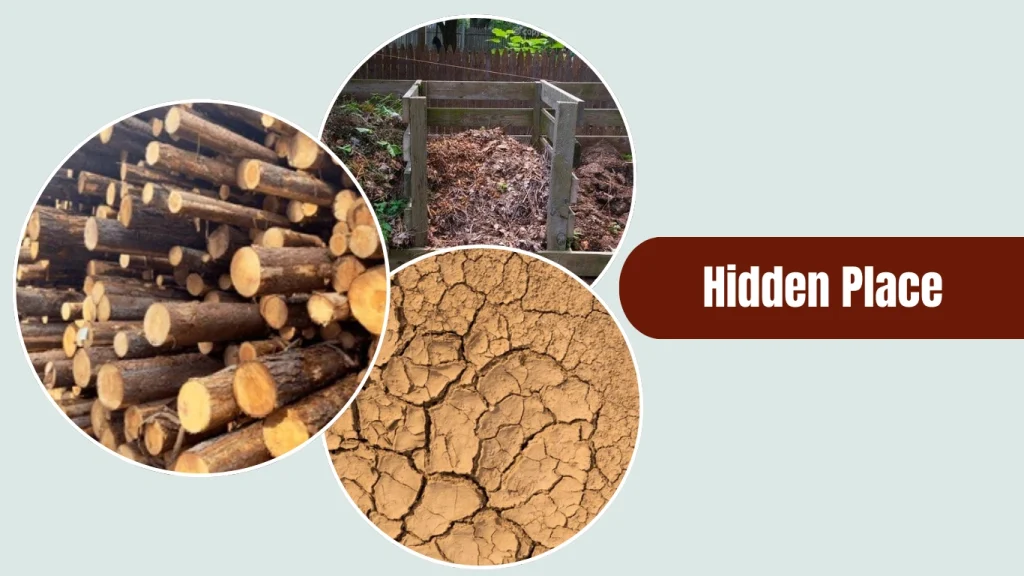
They usually nest in dry, concealed areas, such as:
- Leaf litter and compost piles
- Beneath bark, logs, or stones
- Cracks in dry soil or sandy areas
- Around outdoor debris and garden edges
- In captivity, inside egg cartons or cardboard shelters
Because they are more associated with outdoor or feeder insect use, they are considered a minor nuisance pest rather than a serious household threat.
20. Dusky Cockroach
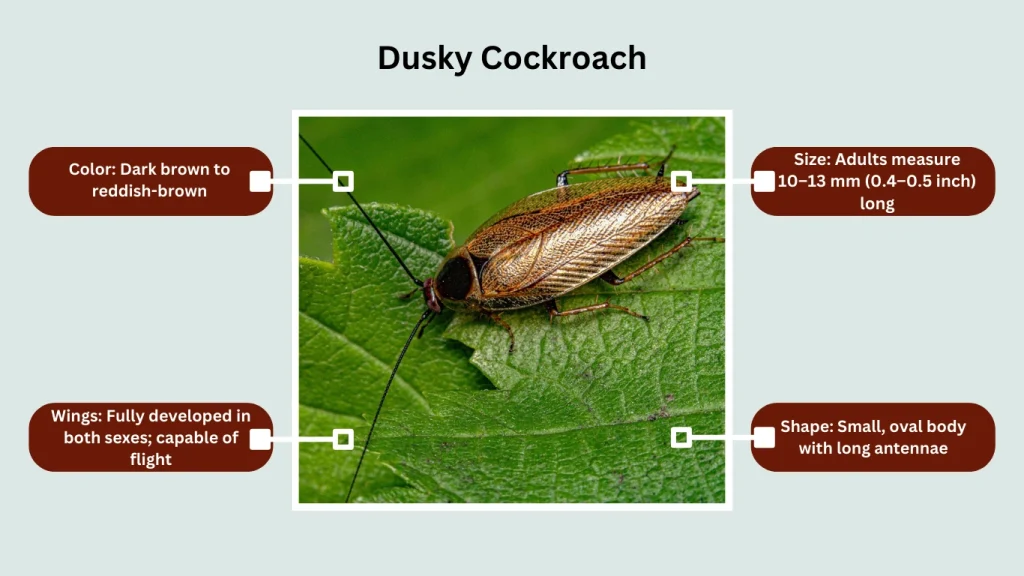
The Dusky cockroach (Ectobius lapponicus) is a small outdoor species native to Europe but now found in parts of North America. Unlike many cockroach pests, the dusky cockroach is considered harmless and does not reproduce indoors. They are usually found in gardens, forests, and fields, where they play a role in recycling organic matter.
Identification
- Color: Dark brown to reddish-brown with a slightly translucent appearance on the wings
- Size: Adults measure 10–13 mm (0.4–0.5 inch) long
- Wings: Fully developed in both sexes; capable of flight
- Shape: Small, oval body with long antennae
- Nymphs: Wingless, dark brown, and more robust in shape
Habitat
Dusky cockroaches prefer outdoor environments, especially in forests, fields, gardens, and areas with leaf litter. They are often seen in summer months when adults become more active and may accidentally enter homes through open windows or doors.
Behavior
This species is not a household pest. They do not breed indoors and rarely survive long inside. Dusky cockroaches are attracted to light and may fly toward houses at night, leading to accidental encounters. They are generally harmless and non-invasive.
Diet
They feed mainly on decaying plant matter, leaves, seeds, and small organic debris. Their role in nature is more ecological, helping break down organic material rather than contaminating food sources.
Nest / Hidden Place
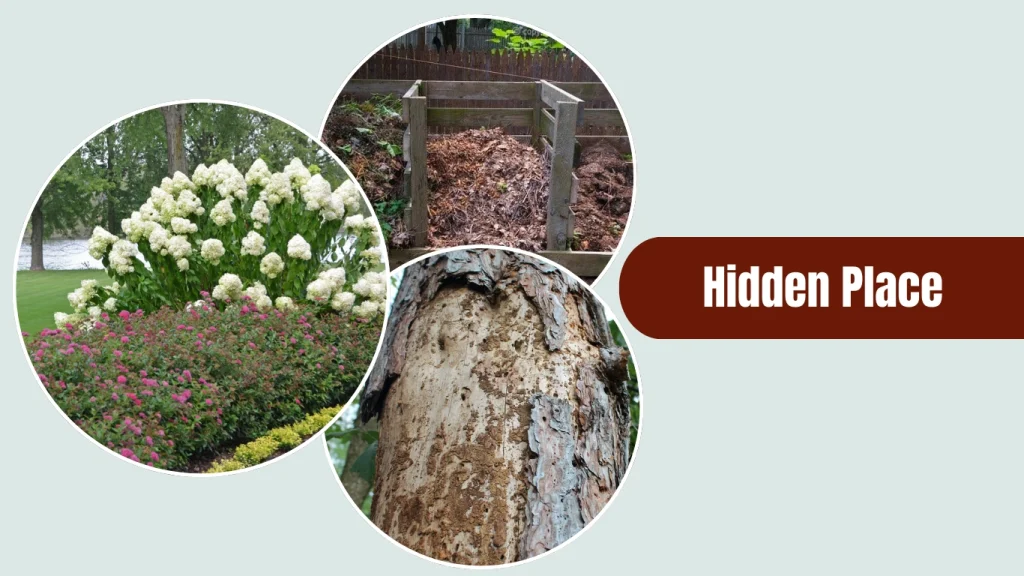
Their nests are entirely outdoors, typically in:
- Leaf litter and garden mulch
- Soil under shrubs and grasses
- Beneath bark or fallen logs
- Woodland floors and compost heaps
- Occasionally near outdoor lights, where adults gather at night
Because they do not infest homes or spread diseases, dusky cockroaches are considered a beneficial insect rather than a true pest.
21. Indian Sand Cockroach
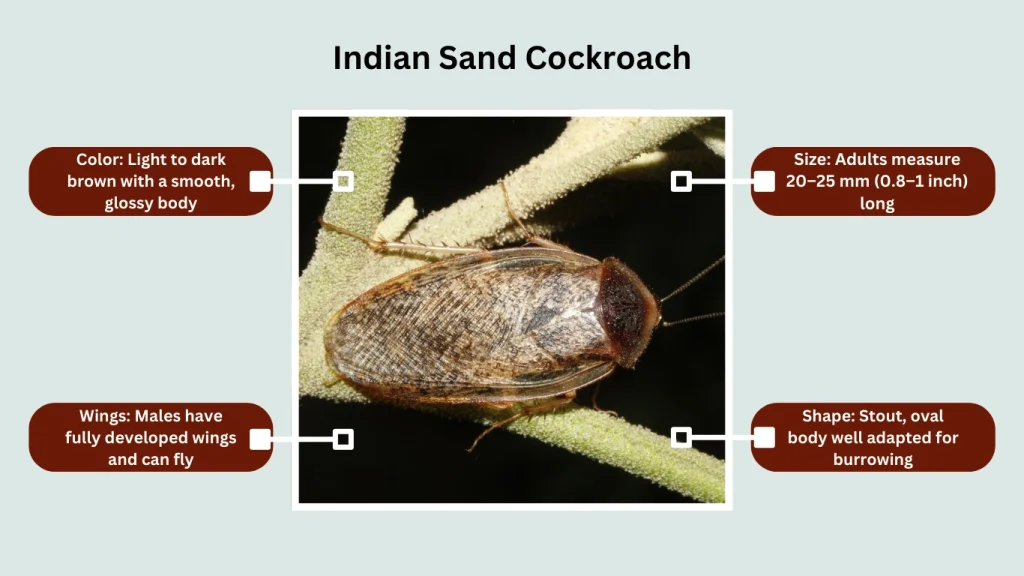
The Indian sand cockroach (Polyphaga aegyptiaca) is a burrowing species commonly found in arid and sandy regions of India, the Middle East, and North Africa. Unlike common household cockroaches, it is adapted to desert conditions and spends much of its life underground. It is not considered a household pest but is of interest in entomology due to its unique habitat preferences.
Identification
- Color: Light to dark brown with a smooth, glossy body
- Size: Adults measure 20–25 mm (0.8–1 inch) long
- Wings: Males have fully developed wings and can fly; females are wingless or have very short wings
- Shape: Stout, oval body well adapted for burrowing
- Nymphs: Wingless, darker brown, and beetle-like in appearance
Habitat
Indian sand cockroaches live in sandy soils and desert environments. They are typically found in sand dunes, arid grasslands, and beneath sparse vegetation. They spend most of their time hidden in burrows, coming out at night to feed.
Behavior
This species is nocturnal and secretive, rarely seen during the day. Males often fly during the breeding season, while females remain burrowed underground. They are non-invasive and do not infest homes, making them an ecologically important but non-pest species.
Diet
They are omnivorous, feeding mainly on decaying plant matter, seeds, roots, and organic soil debris. In harsh desert environments, they adapt to whatever organic material is available.
Nest / Hidden Place
Indian sand cockroaches build underground burrows to escape extreme heat and dryness, including:
- Sandy soil and dunes
- Beneath desert shrubs and grasses
- Under rocks and stones in arid regions
- Shaded soil pockets where moisture is retained
Their underground lifestyle and low pest risk make them very different from urban cockroach species.
22. Tawny Cockroach
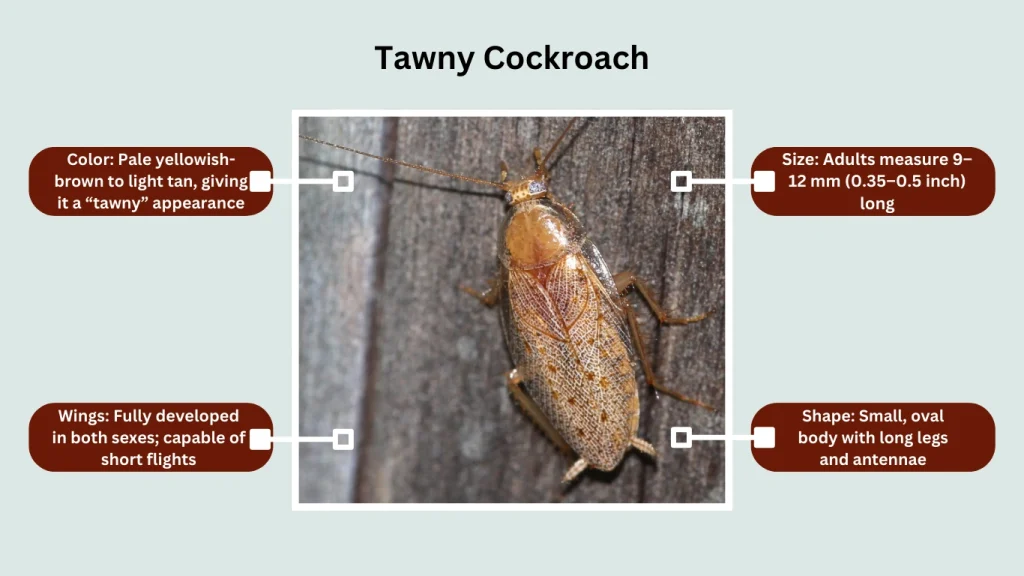
The Tawny cockroach (Ectobius pallidus) is a small, light-colored species native to Europe and parts of the Mediterranean. It is primarily an outdoor cockroach and is rarely considered a household pest. Like other field cockroaches, it plays a beneficial role in ecosystems by feeding on decaying vegetation.
Identification
- Color: Pale yellowish-brown to light tan, giving it a “tawny” appearance
- Size: Adults measure 9–12 mm (0.35–0.5 inch) long
- Wings: Fully developed in both sexes; capable of short flights
- Shape: Small, oval body with long legs and antennae
- Nymphs: Darker than adults, wingless, with lighter markings developing as they grow
Habitat
Tawny cockroaches are found in fields, meadows, gardens, and woodland edges, particularly in Europe. They prefer warm, grassy environments with plenty of ground cover. They are most active in the summer months and sometimes attracted to lights at night.
Behavior
This species is not a household pest and does not reproduce indoors. Tawny cockroaches are nocturnal scavengers and are more likely to be seen outdoors at night. They may accidentally fly into homes through open windows but will not establish infestations.
Diet
Their diet is based on decaying plant matter, seeds, grasses, and organic debris. They contribute to the natural recycling of nutrients in soil and vegetation.
Nest / Hidden Place
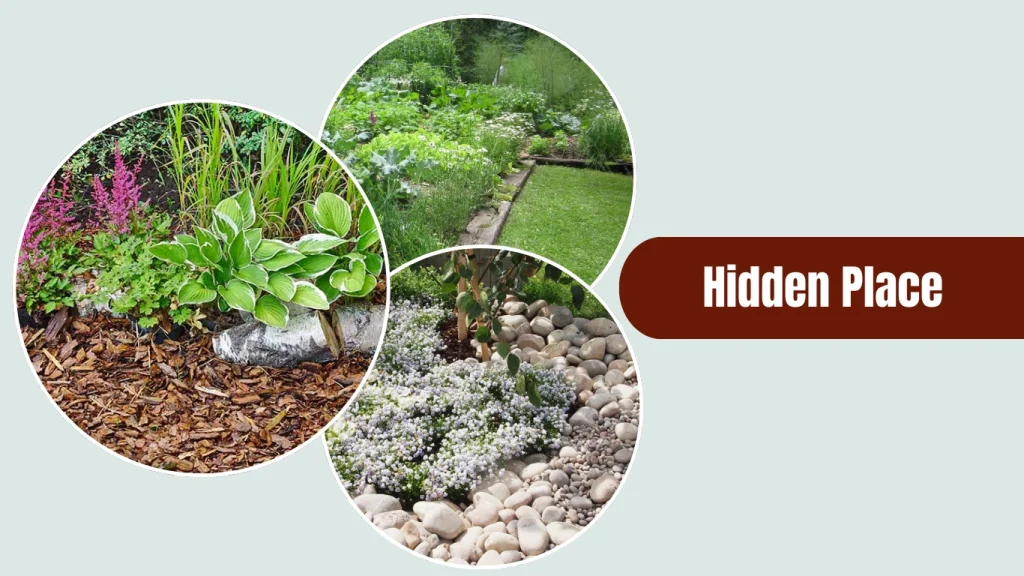
Tawny cockroaches typically nest in outdoor ground litter, such as:
- Grass and meadow vegetation
- Leaf litter and mulch
- Under stones and small logs
- Garden soil and compost heaps
- Occasionally near outdoor lights where they gather at night
Because they do not infest homes, they are regarded as a nuisance invader at most, but otherwise harmless.
23. Harlequin Cockroach
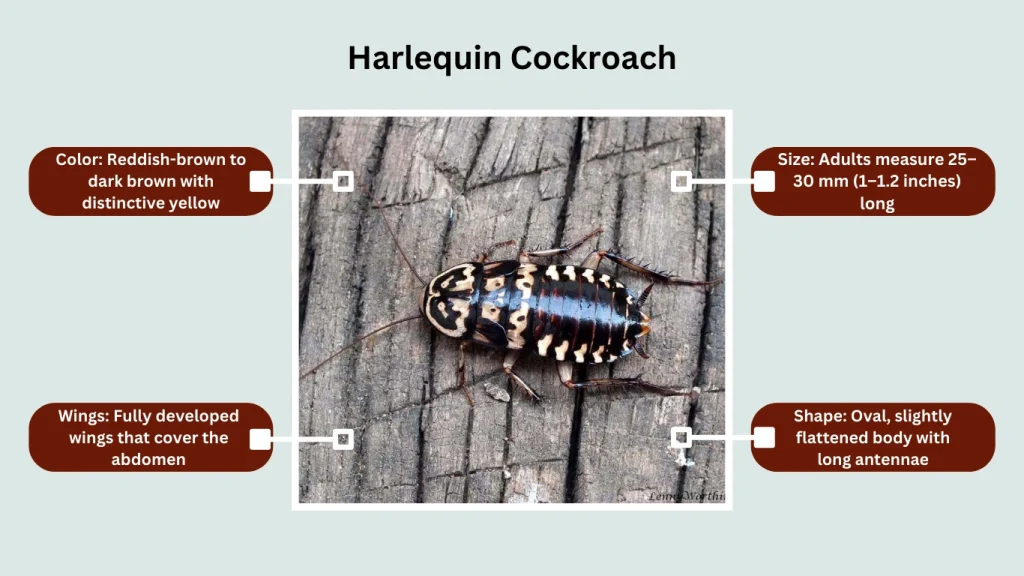
The Harlequin cockroach (Neostylopyga rhombifolia) is a striking and colorful species, often recognized for its patterned wings and body. Native to Asia, it has spread to tropical and subtropical regions worldwide. While it can live indoors, it is more often associated with outdoor environments and is sometimes kept as a display insect because of its appearance.
Identification
- Color: Reddish-brown to dark brown with distinctive yellow or orange markings forming a mosaic-like pattern on the wings
- Size: Adults measure 25–30 mm (1–1.2 inches) long
- Wings: Fully developed wings that cover the abdomen; not strong fliers
- Shape: Oval, slightly flattened body with long antennae
- Nymphs: Darker, wingless, with spotted or striped markings that become more defined with maturity
Habitat
Harlequin cockroaches thrive in warm, moist environments, usually outdoors. They are often found in gardens, compost piles, greenhouses, and under debris. In tropical climates, they may enter homes but are not considered a major indoor pest compared to German cockroaches.
Behavior
This species is nocturnal and hides during the day in dark, sheltered spots. They are fast runners but not strong fliers. Their patterned appearance makes them more noticeable than other cockroaches when disturbed. Harlequin cockroaches reproduce quickly in warm conditions but prefer outdoor habitats.
Diet
They are omnivorous scavengers, feeding on decaying organic matter, fruits, vegetables, starchy items, and food scraps. Outdoors, they play a role in breaking down plant debris. Indoors, they may feed on crumbs and leftovers if available.
Nest / Hidden Place

Harlequin cockroaches usually nest in moist, concealed areas, such as:
- Compost heaps and garden mulch
- Under rocks, logs, and outdoor debris
- Greenhouses and plant nurseries
- Cracks in walls and basements in humid houses
- Storage areas with organic waste
Their colorful patterns make them unique among cockroaches, but they remain more of an occasional invader than a household pest.
24. Black Cockroach
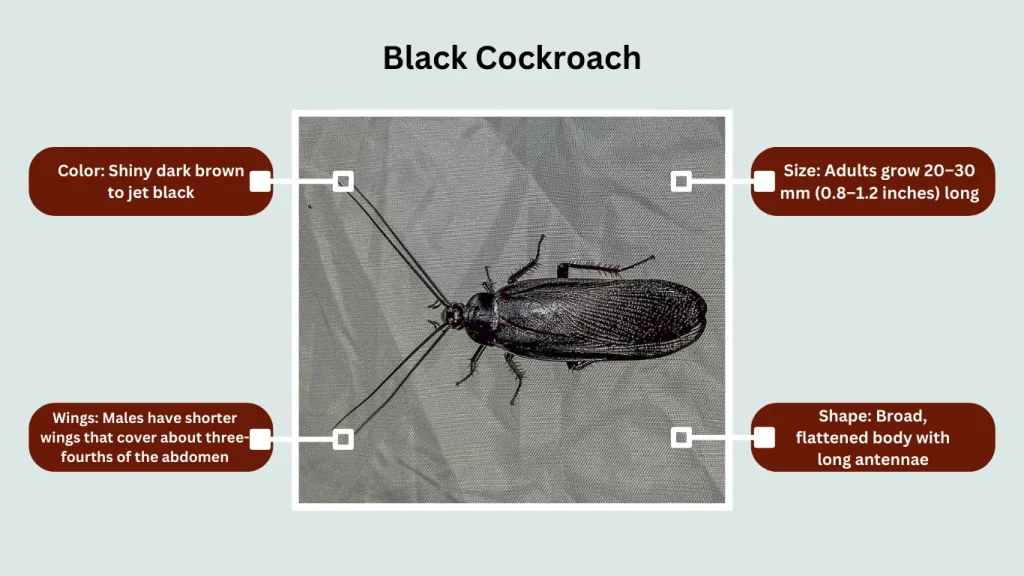
The Black cockroach (Blatta orientalis var. and other closely related dark species) is a term often used for very dark-colored cockroaches, most commonly the Oriental cockroach and its darker variations. These cockroaches are slow-moving, large, and often associated with damp and unsanitary environments. They are notorious for spreading bacteria due to their habitat preferences.
Identification
- Color: Shiny dark brown to jet black
- Size: Adults grow 20–30 mm (0.8–1.2 inches) long
- Wings: Males have shorter wings that cover about three-fourths of the abdomen; females have tiny wing pads and cannot fly
- Shape: Broad, flattened body with long antennae
- Nymphs: Wingless, black, and robust in shape
Habitat
Black cockroaches prefer cool, damp, and dark environments. They are most commonly found in basements, drains, sewers, crawl spaces, and under leaky pipes. Outdoors, they inhabit leaf litter, mulch piles, and compost heaps.
Behavior
They are nocturnal and avoid light, hiding during the day in cracks and crevices. Unlike faster species such as German cockroaches, black cockroaches are slow movers. They are known for producing a strong, unpleasant odor when present in large numbers.
Diet
Black cockroaches are scavengers that feed on decaying organic matter, garbage, starchy foods, and plant debris. They can also consume paper, cloth, and soap if food is scarce. Their feeding habits make them a vector for disease-causing bacteria.
Nest / Hidden Place

They usually nest in moist, concealed areas, including:
- Sewer and drainage systems
- Cracks in damp basements and crawl spaces
- Around sinks, washing machines, and water heaters
- Outdoor mulch, rotting wood, and compost piles
- Beneath garden debris and stones
Because of their association with filth, black cockroaches are considered one of the dirtiest and most problematic species in urban environments.
25. Shining Cockroach
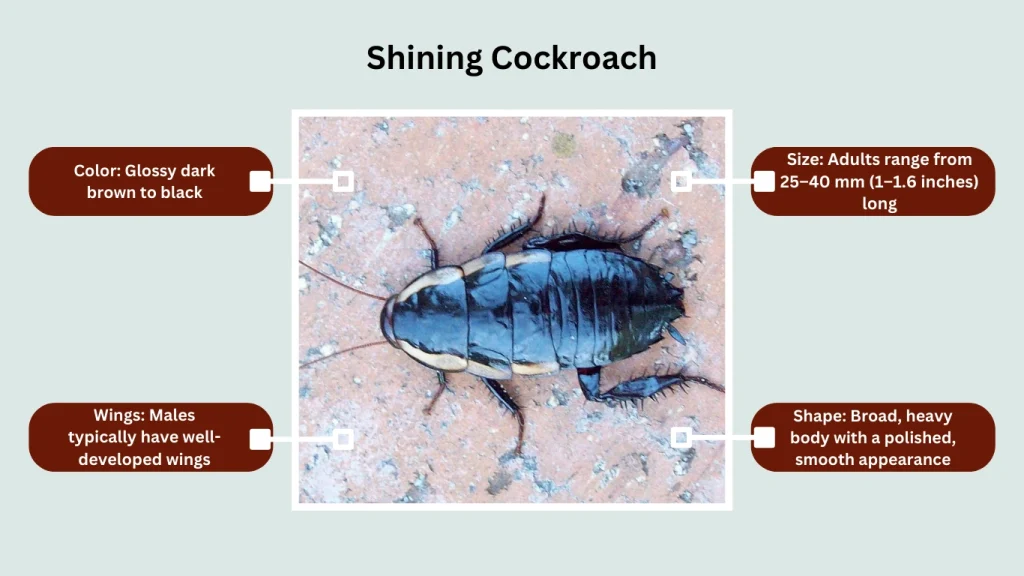
The Shining cockroach (Lucihormetica subcincta and related species) is a large, glossy species native to Central and South America. It is well known for its smooth, shiny exoskeleton and in some species, faint glowing spots. These cockroaches are more often studied or kept by insect hobbyists than considered household pests.
Identification
- Color: Glossy dark brown to black, sometimes with lighter markings or faint spots
- Size: Adults range from 25–40 mm (1–1.6 inches) long
- Wings: Males typically have well-developed wings; females may have reduced wings or none at all
- Shape: Broad, heavy body with a polished, smooth appearance
- Nymphs: Wingless, robust, and dark with a shiny surface
Habitat
Shining cockroaches prefer humid tropical and subtropical environments. They are found in rainforests, under logs, leaf litter, and moist soil. They require high humidity and warmth, which is why they are rarely seen in temperate climates unless kept in captivity.
Behavior
They are nocturnal and remain hidden during the day. Some species in this group display bioluminescence-like glowing spots, though not as strongly as fireflies. They are not aggressive invaders of homes but may be encountered in tropical outdoor settings.
Diet
Shining cockroaches are omnivorous scavengers, primarily feeding on decaying plant matter, fruits, seeds, and organic debris. Their diet helps recycle nutrients in forest ecosystems.
Nest / Hidden Place
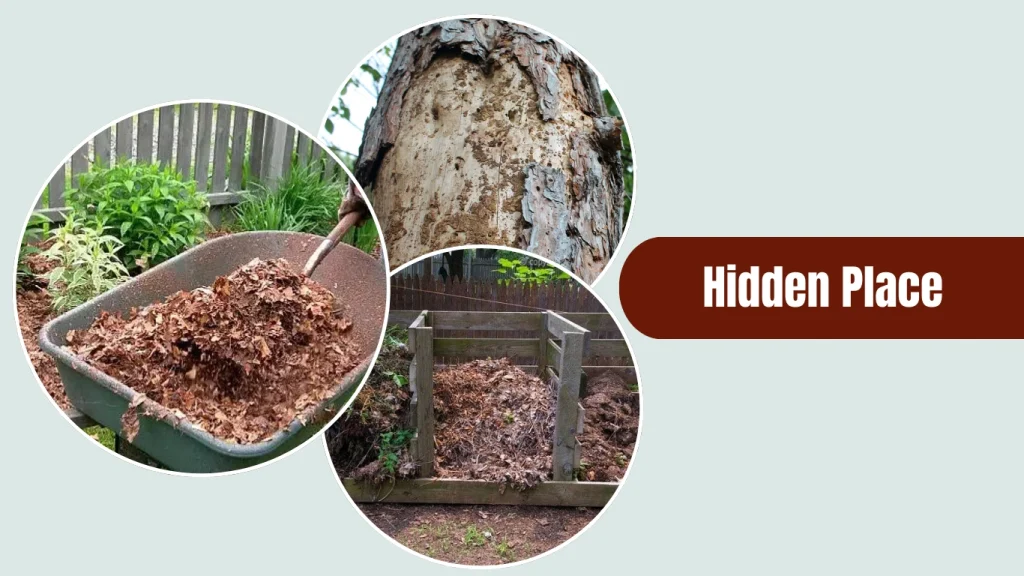
They typically nest in moist, concealed locations, such as:
- Beneath rotting logs and tree bark
- Leaf litter and damp forest soil
- Compost heaps and organic debris outdoors
- Cracks and crevices in tropical wooden structures
- Captive terrariums when bred by hobbyists
Due to their glossy bodies and occasional light-emitting traits, they are considered one of the more visually striking cockroach species.
26. Banana Cockroach
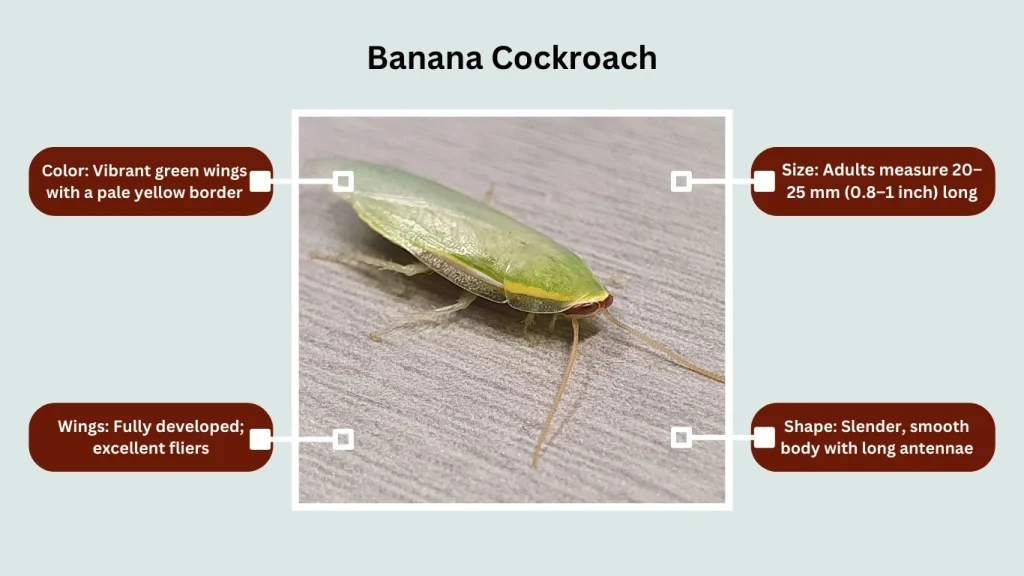
The Banana cockroach (Panchlora nivea), also known as the green banana cockroach, is a bright green species often confused with the Cuban cockroach. It is native to tropical regions of Central and South America and is commonly found in banana plantations and other areas with lush vegetation. Despite its striking appearance, it is not considered a household pest.
Identification
- Color: Vibrant green wings with a pale yellow border; body beneath wings is pale brown
- Size: Adults measure 20–25 mm (0.8–1 inch) long
- Wings: Fully developed; excellent fliers
- Shape: Slender, smooth body with long antennae
- Nymphs: Brown to black, wingless, and very different in appearance from adults
Habitat
Banana cockroaches prefer tropical outdoor environments, especially in banana plants, palm trees, greenhouses, and gardens. They thrive in warm, humid climates and are rarely found indoors unless carried in with produce or attracted to lights.
Behavior
This species is nocturnal and strongly attracted to lights, often flying toward porch lights or windows at night. They are fast fliers and can cover significant distances. Unlike German or American cockroaches, they do not infest kitchens or reproduce inside homes.
Diet
Banana cockroaches are herbivorous scavengers, feeding primarily on decaying leaves, fruit, and other plant material. Their diet makes them ecologically beneficial, as they help break down organic matter in tropical ecosystems.
Nest / Hidden Place
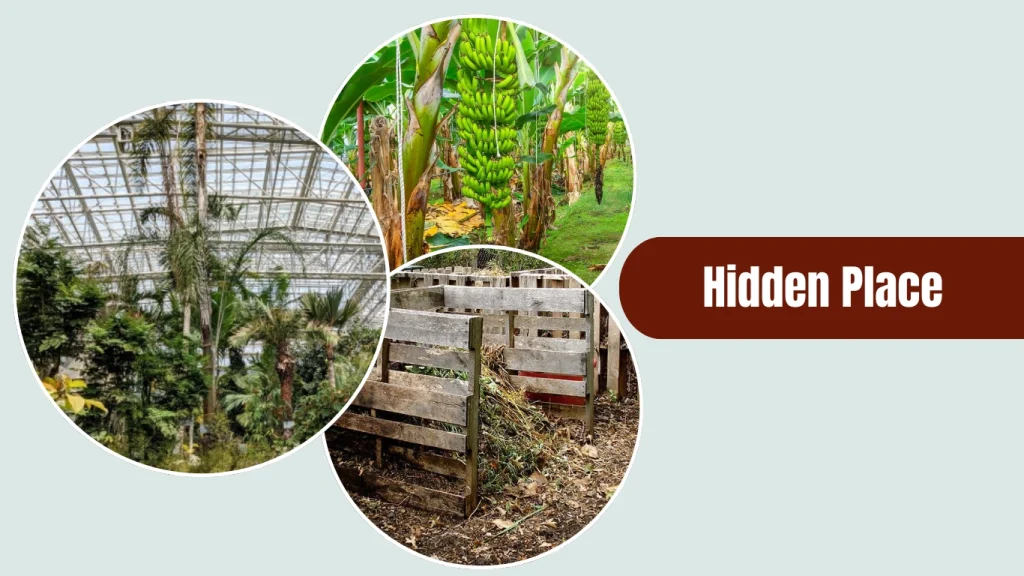
They usually nest in lush vegetation and moist organic debris, such as:
- Banana plants and palm fronds
- Greenhouses and ornamental gardens
- Leaf litter and compost piles
- Moist soil near tropical plants
- Outdoor shrubs and hedges
Their bright green color makes them one of the most visually distinctive cockroach species.
27. Lesser Cockroach
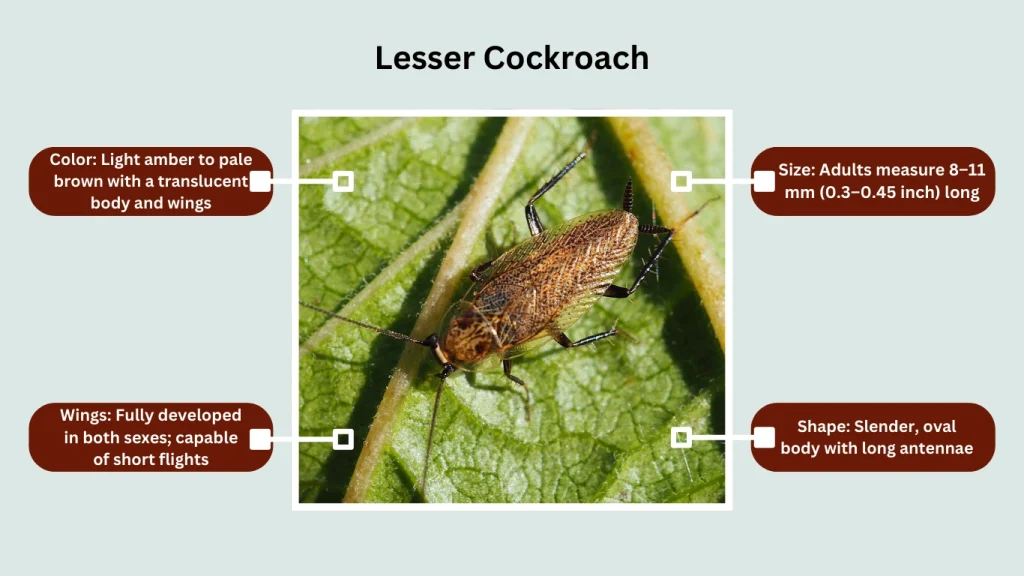
The Lesser cockroach (Ectobius panzeri), also called the amber field cockroach, is a small outdoor species native to Europe but also found in parts of North America. Unlike common household pests, this species lives mainly outdoors and rarely survives indoors, making it more of a nuisance invader than a true pest.
Identification
- Color: Light amber to pale brown with a translucent body and wings
- Size: Adults measure 8–11 mm (0.3–0.45 inch) long
- Wings: Fully developed in both sexes; capable of short flights
- Shape: Slender, oval body with long antennae
- Nymphs: Darker brown, wingless, and smaller, gradually becoming lighter as they mature
Habitat
Lesser cockroaches live in fields, gardens, meadows, and woodland edges. They thrive in leaf litter, low grasses, and garden soil. They are especially active during the summer and may accidentally fly into houses at night when attracted to lights.
Behavior
They are outdoor-dwelling insects and do not establish infestations indoors. Lesser cockroaches are nocturnal scavengers and fast movers. Because of their small size and translucent appearance, they are sometimes overlooked in gardens and fields.
Diet
Their diet mainly consists of decaying plant matter, seeds, grasses, and organic debris. Outdoors, they play an important role in breaking down vegetation and returning nutrients to the soil.
Nest / Hidden Place
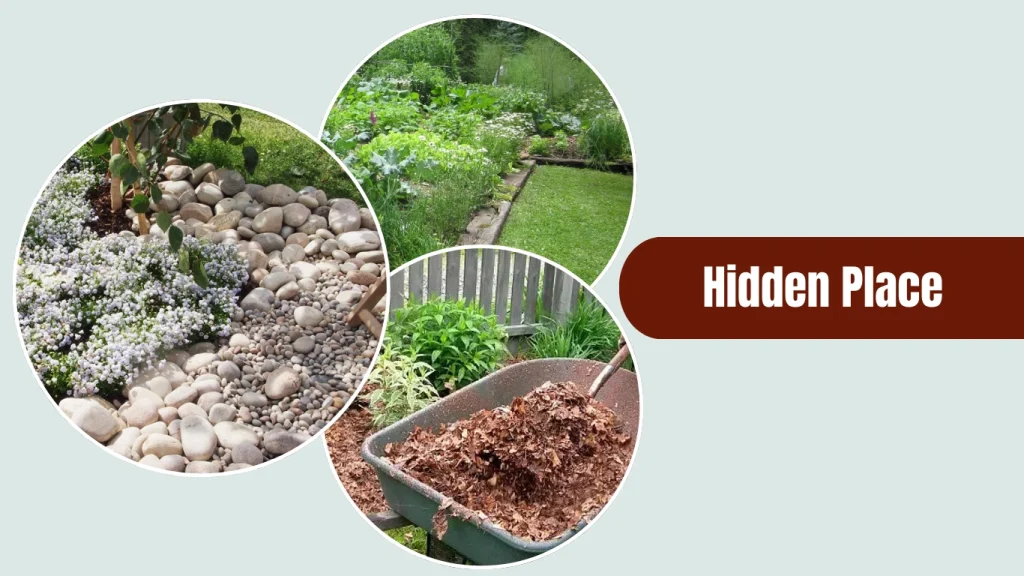
Lesser cockroaches nest in outdoor ground litter and vegetation, such as:
- Grass beds and meadows
- Leaf litter and mulch
- Beneath stones, small logs, and garden debris
- Soil pockets in shaded areas
- Occasionally in garages or sheds when carried in with plants or soil
Because they are harmless to humans and do not infest kitchens, they are often considered beneficial insects in natural environments.
28. Common Wood Cockroach
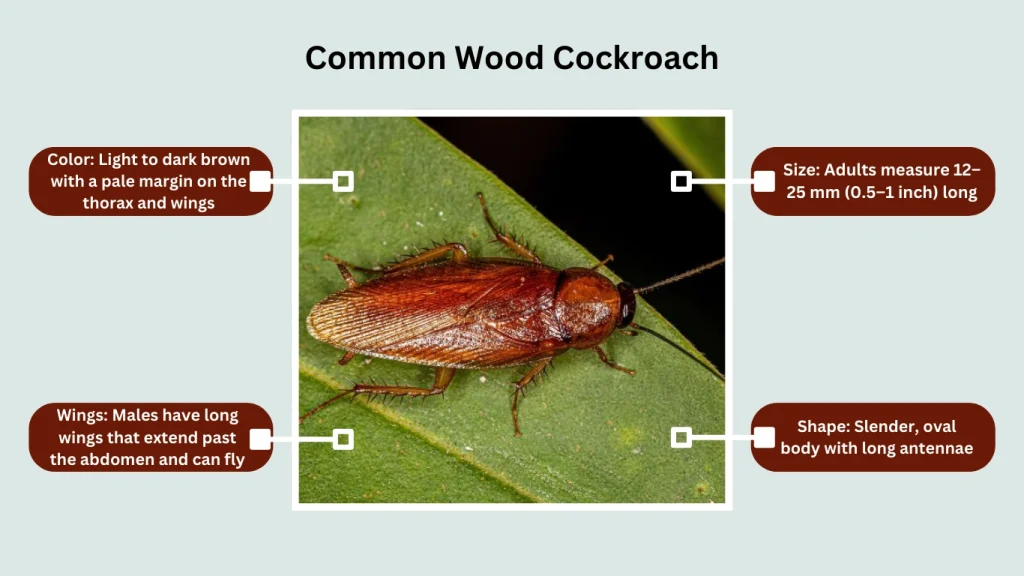
The Common wood cockroach (Parcoblatta americana and related Parcoblatta species) is a North American outdoor species often mistaken for pest cockroaches when it enters homes. Unlike German or American cockroaches, wood cockroaches do not reproduce indoors, making them more of a seasonal nuisance than a true household pest.
Identification
- Color: Light to dark brown with a pale margin on the thorax and wings
- Size: Adults measure 12–25 mm (0.5–1 inch) long
- Wings: Males have long wings that extend past the abdomen and can fly; females have shorter wings and cannot fly
- Shape: Slender, oval body with long antennae
- Nymphs: Wingless, darker brown, and similar in shape to adults
Habitat
Common wood cockroaches prefer outdoor wooded environments, where they are found under loose bark, logs, firewood piles, leaf litter, and mulch. They are especially common in homes surrounded by forests and wooded areas.
Behavior
This species is not an indoor breeder. Males are strongly attracted to lights and often fly into homes during summer nights. Females and nymphs stay outdoors, hidden under debris. Wood cockroaches are not as secretive as German cockroaches and may be seen crawling in open areas.
Diet
They are scavengers, feeding primarily on decaying organic matter, bark, leaves, and wood debris. Indoors, they may feed on crumbs or scraps but do not infest kitchens or stored food.
Nest / Hidden Place
Common wood cockroaches build their nests outdoors in:
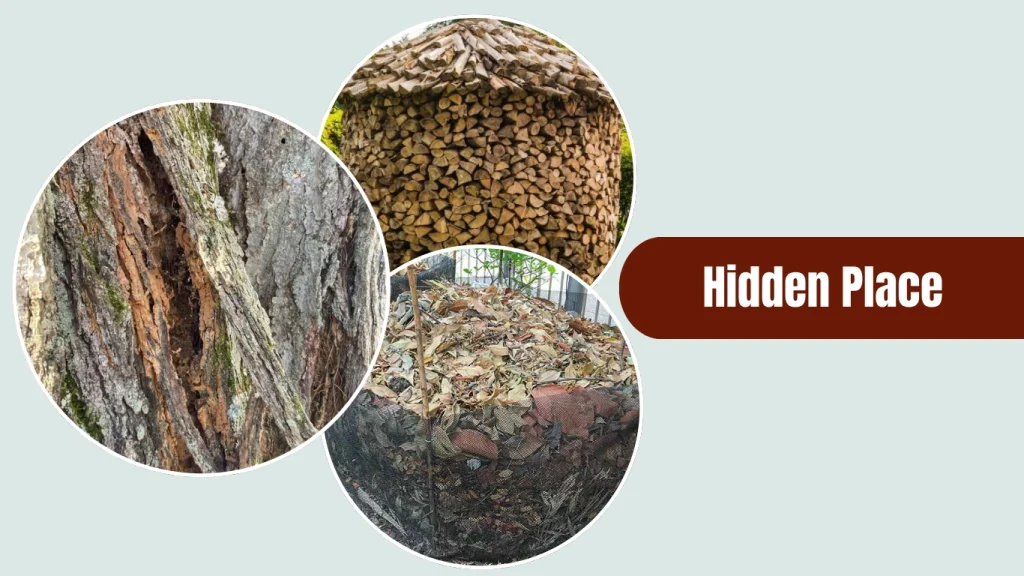
- Firewood and stacked logs
- Beneath loose tree bark
- Leaf litter and mulch beds
- Hollow logs and tree stumps
- Garden debris and shaded soil
Since they cannot establish colonies inside houses, control usually involves managing firewood and outdoor debris rather than indoor treatments.
29. Wingless Cockroach
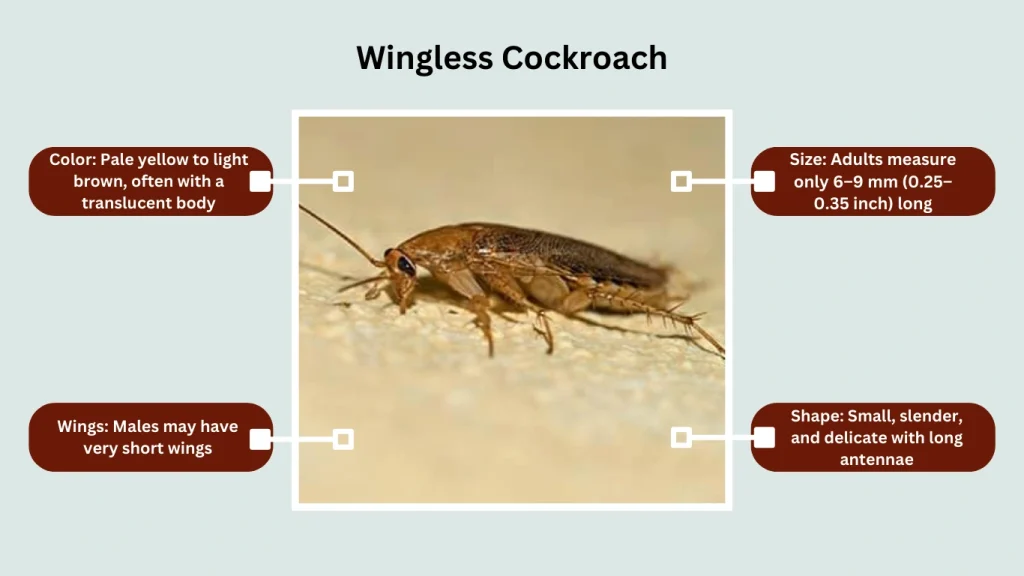
The Wingless cockroach (Cariblatta lutea), also known as the small yellow cockroach, is a tiny species native to the southeastern United States. True to its name, it has very reduced or absent wings, especially in females. It is primarily an outdoor species that lives in leaf litter and grassy areas, rarely becoming a household pest.
Identification
- Color: Pale yellow to light brown, often with a translucent body
- Size: Adults measure only 6–9 mm (0.25–0.35 inch) long
- Wings: Males may have very short wings; females are typically wingless
- Shape: Small, slender, and delicate with long antennae
- Nymphs: Very similar in appearance to females, wingless and pale yellow
Habitat
Wingless cockroaches prefer moist, shaded outdoor environments, such as leaf litter, grassy areas, mulch beds, and forest floors. They are especially common in warm and humid regions. Indoors, they may occasionally appear if carried in with soil, plants, or garden materials.
Behavior
They are shy and secretive, hiding during the day and becoming active at night. Unlike pest species, they do not infest kitchens or bathrooms and cannot survive long inside homes. Wingless cockroaches are fast-moving but rarely climb walls or travel far from ground cover.
Diet
Their diet consists mostly of decaying plant matter, seeds, and small bits of organic debris found outdoors. They play an ecological role in recycling nutrients but do not compete with pest species for human food.
Nest / Hidden Place
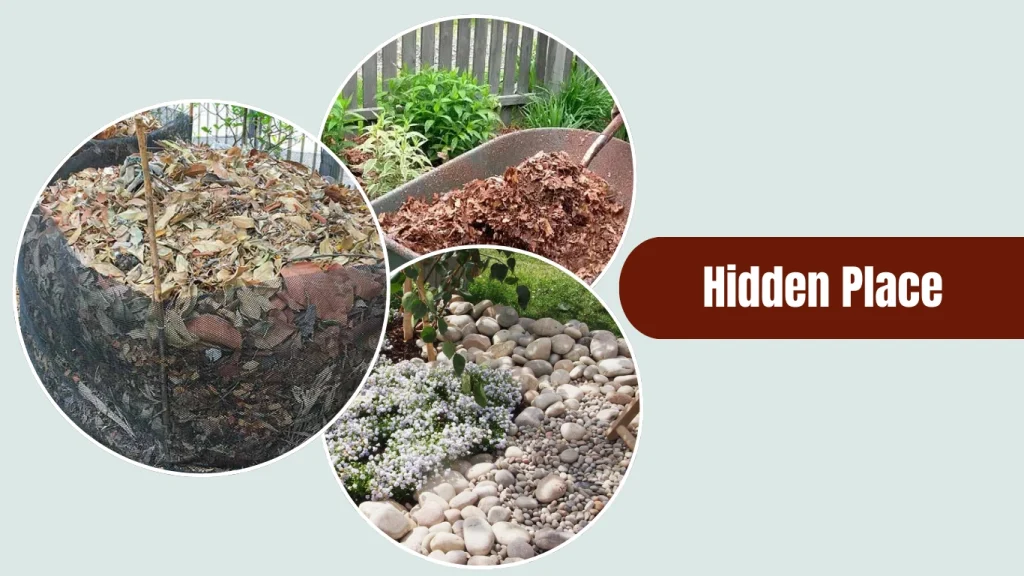
They usually nest in outdoor ground litter, such as:
- Leaf litter and mulch beds
- Grass clippings and soil debris
- Beneath stones, logs, and garden refuse
- Moist soil around shrubs and plants
- Compost heaps and shaded garden areas
Because of their small size, pale color, and lack of wings, they are rarely noticed and almost never cause concern for homeowners.
30. Field Cockroach
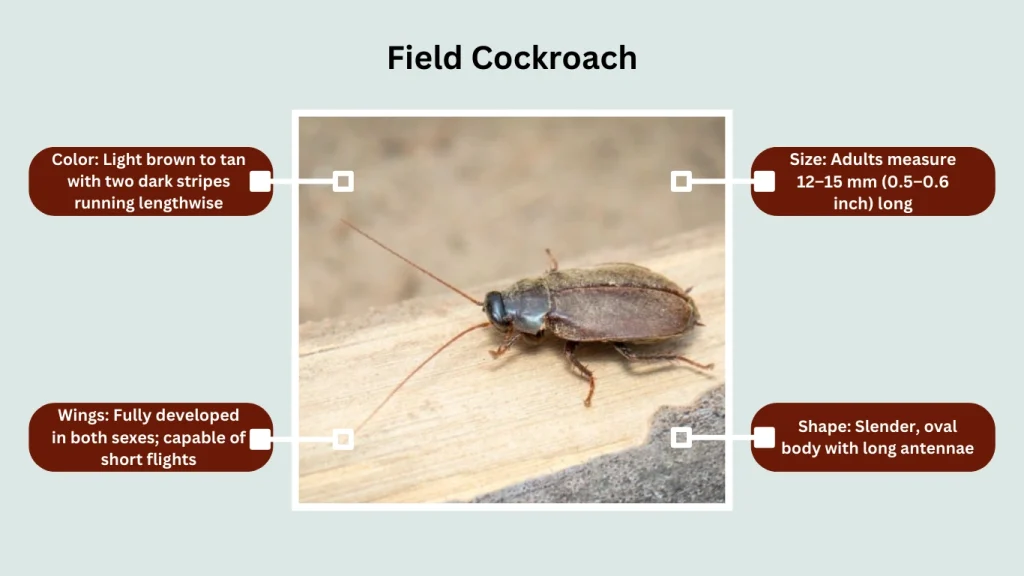
The Field cockroach (Blattella vaga) is a small outdoor species that closely resembles the German cockroach but has key differences in behavior and habitat. Unlike German cockroaches, they prefer to live outdoors and do not typically infest homes. They are commonly found in southwestern regions of the United States, Mexico, and other warm climates.
Identification
- Color: Light brown to tan with two dark stripes running lengthwise on the pronotum
- Size: Adults measure 12–15 mm (0.5–0.6 inch) long
- Wings: Fully developed in both sexes; capable of short flights
- Shape: Slender, oval body with long antennae
- Nymphs: Smaller, wingless, and darker brown in appearance
Habitat
Field cockroaches prefer warm outdoor environments, such as gardens, fields, grassy areas, and under mulch or leaf litter. They are often found in irrigated landscapes, near soil, or in compost piles. Indoors, they rarely survive for long.
Behavior
This species is primarily outdoor-dwelling and only occasionally enters houses, often by mistake. Unlike the German cockroach, it does not establish long-term infestations indoors. They are active at night and sometimes attracted to lights.
Diet
Field cockroaches are omnivores, feeding mainly on decaying plant matter, leaves, seeds, and organic waste. They may consume crumbs or food scraps if they enter homes, but they are not adapted to human dwellings.
Nest / Hidden Place
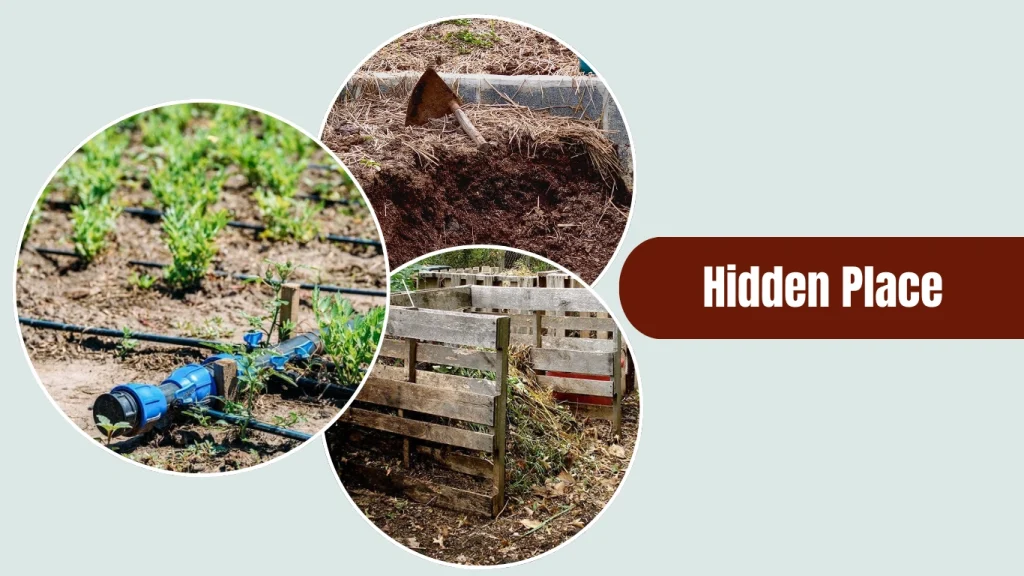
Their nests are usually outdoors in:
- Leaf litter and garden mulch
- Soil near irrigation systems
- Compost piles and grass clippings
- Beneath stones, logs, and outdoor debris
- Cracks in soil or near building foundations
Because they prefer outdoor habitats and do not infest human structures, field cockroaches are considered nuisance pests rather than serious threats.