

The German cockroach (Blattella germanica) is one of the most common and troublesome pests found in homes, restaurants, and apartments worldwide. Known for its rapid reproduction and ability to survive in challenging environments, this species is particularly difficult to eliminate once it becomes established. Understanding the life cycle and lifespan of German cockroaches is essential for effective pest control. By knowing how they develop from eggs to adults, we can identify weak points in their growth and apply targeted strategies to break the cycle.
Identification of German Cockroach
Before examining their life stages, it is helpful to recognize what German cockroaches look like. Adults are typically ½ to ⅝ inches long, light brown to tan, with two dark stripes running down the pronotum (the shield-like plate behind the head). Unlike larger roaches such as the American cockroach, German cockroaches are smaller and better adapted to indoor living.
Nymphs (juveniles) are darker, wingless, and much smaller than adults. Egg cases, or oothecae, are light brown capsules that females carry or deposit in hidden areas. These three distinct forms—eggs, nymphs, and adults—make up their entire life cycle.
Life Cycle Stages

1. Egg Stage
The German cockroach life cycle begins with the ootheca, a protective egg case produced by the female. Each ootheca contains 30 to 40 eggs, making German cockroaches highly prolific breeders. Unlike some other cockroach species that drop their egg cases quickly, females often carry the ootheca attached to their bodies until it is close to hatching. This behavior provides added protection to the developing embryos.
The incubation period usually lasts 20 to 30 days, depending on temperature and humidity. Warm, moist environments accelerate hatching, while cooler conditions slow the process. When the eggs hatch, tiny nymphs emerge, ready to begin feeding and growing immediately.
2. Nymph Stage
After hatching, cockroaches enter the nymph stage, which is the longest and most critical part of their development. Nymphs are wingless, dark brown to black, and smaller than adults. Over time, they undergo 6 to 7 molts, shedding their exoskeleton to grow larger with each stage.
During this period, nymphs feed on crumbs, grease, food residues, and even non-food materials like glue or soap. Their rapid feeding and constant growth make them a persistent problem in infested homes. The length of the nymph stage depends on environmental conditions. In warm and food-rich environments, nymphs may mature into adults in as little as 6 weeks, but under less favorable conditions, the stage can extend to several months.
Each molt brings the nymph closer to its adult form, eventually developing light brown coloration and fully functional wings. By the time they reach adulthood, German cockroaches are ready to reproduce, continuing the cycle at alarming speed.
3. Adult Stage
The final stage is the adult German cockroach, which is fully winged, though not a strong flier. Adults typically live between 100 and 200 days, but within that time, they reproduce prolifically. A single female can produce multiple oothecae during her life, each containing dozens of eggs. This means that just a few roaches can quickly multiply into hundreds within a few months.
Adults are most active at night, seeking food, water, and mates. They are social insects that congregate in warm, moist areas, often hiding during the day and emerging after dark. Their resilience, coupled with their ability to reproduce so rapidly, explains why infestations escalate so quickly if not addressed early.
Lifespan of German Cockroaches
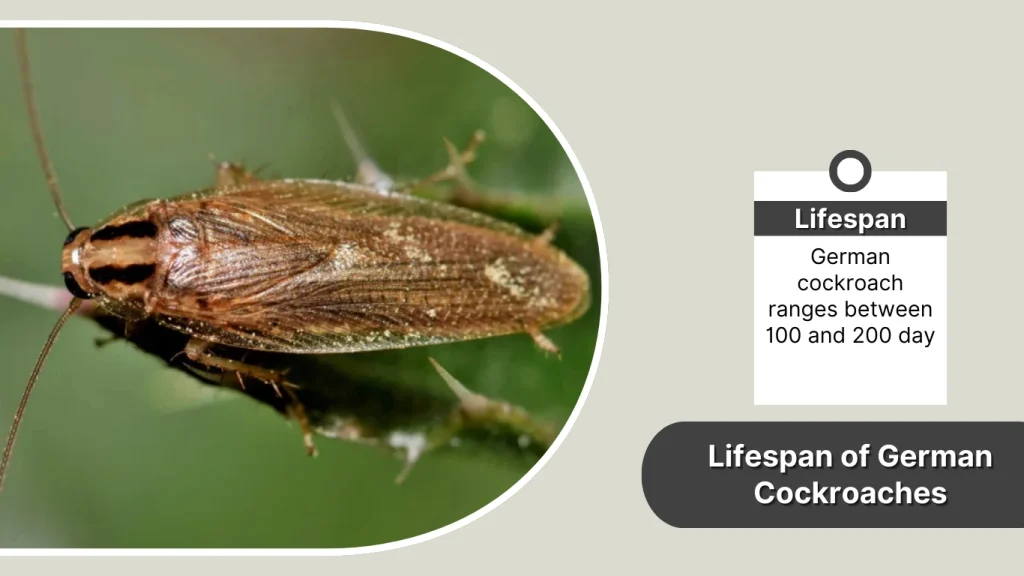
The average lifespan of a German cockroach ranges between 100 and 200 days, though this depends heavily on environmental conditions. In ideal settings—warm, humid environments with abundant food and water—roaches live longer and reproduce more frequently. In less favorable conditions, their survival period shortens significantly.
A key factor in their long-term survival is their reproductive capacity. A single female can produce four to eight oothecae during her lifetime, with each capsule holding up to 40 eggs. This means one female and her offspring can generate thousands of cockroaches in a single year. Such reproductive efficiency makes them one of the most difficult pests to control once established indoors.
Environmental Conditions and Survival
German cockroaches thrive in warm, humid environments, typically between 70°F and 85°F. They are most commonly found in kitchens and bathrooms because of the steady supply of food, warmth, and moisture. Leaky pipes, unsealed food containers, and greasy stovetops create perfect survival conditions.
When resources are limited, German cockroaches adapt remarkably well. They can survive on very small amounts of food, and in extreme cases, they have been known to feed on non-food items such as soap residue, glue, and even hair. Their adaptability is one of the reasons they have successfully spread across homes and commercial spaces worldwide.
Why Their Life Cycle Matters for Control

Understanding the German cockroach life cycle is critical for effective pest management. Each stage—egg, nymph, and adult—presents unique challenges:
- Eggs (oothecae): Resistant to many pesticides. Treatments must focus on preventing new egg cases from hatching.
- Nymphs: Constantly feeding and molting, making them vulnerable to baits, but also quick to mature into adults.
- Adults: Reproductive stage, capable of generating new oothecae quickly.
This is why pest control strategies often focus on breaking the cycle rather than killing adults alone. Tools like insect growth regulators (IGRs) prevent nymphs from reaching adulthood, while sanitation and baiting ensure fewer resources are available to support new generations. By targeting every stage, infestations can be controlled more effectively and permanently.
Conclusion
The German cockroach life cycle, from egg to adult, is a finely tuned system that enables this pest to reproduce rapidly and thrive in human environments. With lifespans ranging from 100 to 200 days, combined with prolific egg production, they can build overwhelming populations in just a few months.
FAQs
How long do German cockroaches live?
German cockroaches generally live between 100 and 200 days, though their lifespan depends on temperature, humidity, and access to food and water.
How many eggs can a female German cockroach produce?
A single female produces four to eight oothecae in her lifetime, with each egg case holding 30–40 eggs.
How fast do German cockroach infestations grow?
Infestations can expand quickly. Under favorable conditions, a small number of roaches can become hundreds within just a few months.
Do German cockroaches die after laying eggs?
No. Females continue to live after laying eggs and can produce multiple egg cases over their lifespan.
What environmental conditions make them live longer?
Warm, humid areas with plenty of food and water help German cockroaches survive longer. Kitchens, bathrooms, and places with leaks provide the best conditions.